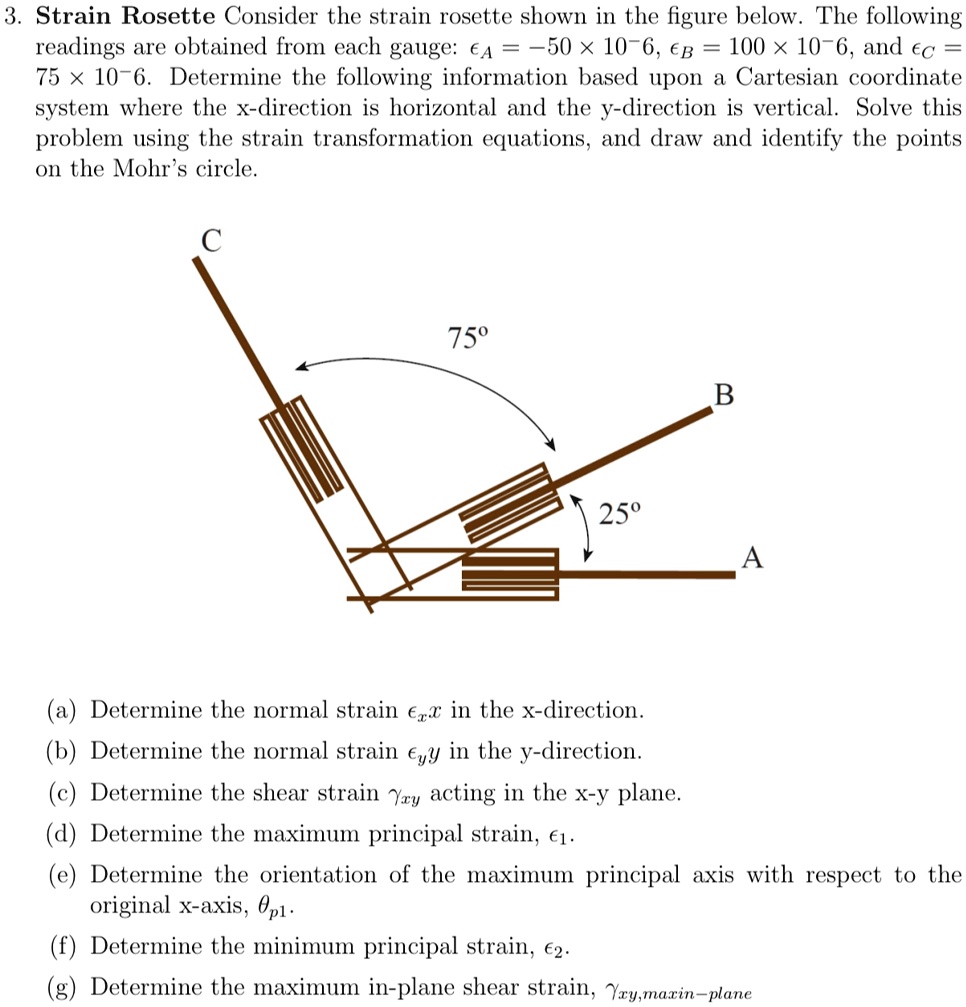
3. Strain Rosette Consider the strain rosette shown in the figure below. The following readings are obtained from each gauge: $\epsilon_A = -50 \times 10^{-6}$, $\epsilon_B = 100 \times 10^{-6}$, and $\epsilon_C = 75 \times 10^{-6}$. Determine the following information based upon a Cartesian coordinate system where the x-direction is horizontal and the y-direction is vertical. Solve this problem using the strain transformation equations, and draw and identify the points on the Mohr's circle.
(a) Determine the normal strain $\epsilon_x$ in the x-direction.
(b) Determine the normal strain $\epsilon_y$ in the y-direction.
(c) Determine the shear strain $\gamma_{xy}$ acting in the x-y plane.
(d) Determine the maximum principal strain, $\epsilon_1$.
(e) Determine the orientation of the maximum principal axis with respect to the original x-axis, $\theta_{p1}$.
(f) Determine the minimum principal strain, $\epsilon_2$.
(g) Determine the maximum in-plane shear strain, $\gamma_{xy, max-plane}$