Texts: Prove that additive inverse elements exist in Zm and show that the additive inverse property holds for Zm. Using the notation defined in the Assumptions section, justify each step, including naming the specific property or operation definition that applies to that step. When m = 79.
ASSUMPTIONS
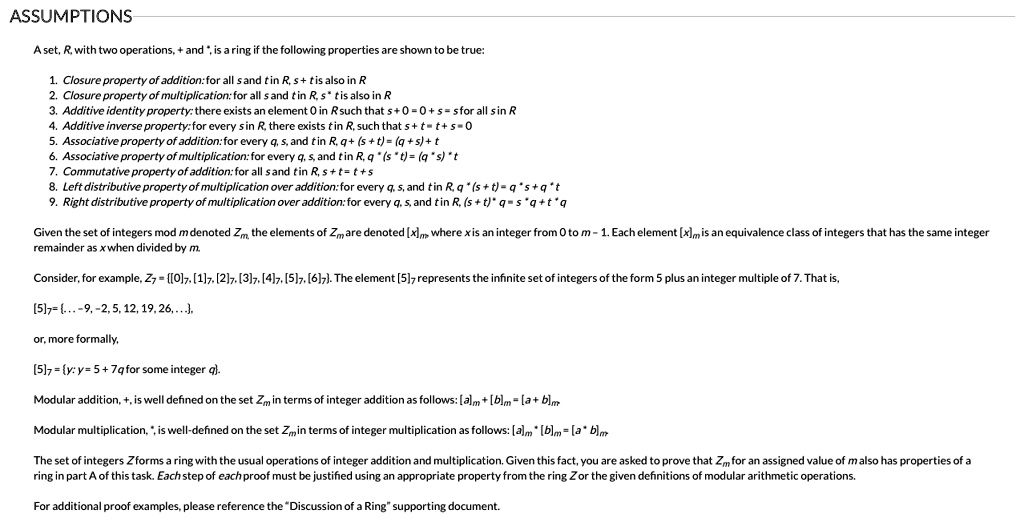
A set, R, with two operations, + and *, is a ring if the following properties are shown to be true:
1. Closure property of addition: for all s and t in R, s + t is also in R.
2. Closure property of multiplication: for all s and t in R, s * t is also in R.
3. Additive identity property: there exists an element O in R such that s + O = O + s = s for all s in R.
4. Additive inverse property: for every s in R, there exists t in R such that s + t = t + s = 0.
5. Associative property of addition: for every q, s, and t in R, q + (s + t) = (q + s) + t.
6. Associative property of multiplication: for every q, s, and t in R, q * (s * t) = (q * s) * t.
7. Commutative property of addition: for all s and t in R, s + t = t + s.
8. Left distributive property of multiplication over addition: for every q, s, and t in R, q * (s + t) = q * s + q * t.
9. Right distributive property of multiplication over addition: for every q, s, and t in R, (s + t) * q = s * q + t * q.
Given the set of integers mod m denoted Zm, the elements of Zm are denoted [x]m, where x is an integer from 0 to m - 1. Each element [x]m is an equivalence class of integers that has the same integer remainder as x when divided by m.
Consider, for example, Zm = {[0]m, [1]m, [2]m, [3]m, [4]m, [5]m, [6]m}. The element [5]m represents the infinite set of integers of the form 5 plus an integer multiple of 7. That is,
[5]m = {..., -9, -2, 5, 12, 19, 26, ...},
or, more formally,
[5]m = {y: y = 5 + 7q for some integer q}.
Modular addition, +, is well defined on the set Zm in terms of integer addition as follows: [a]m + [b]m = [a + b]m.
Modular multiplication, *, is well-defined on the set Zm in terms of integer multiplication as follows: [a]m * [b]m = [a * b]m.
The set of integers Z forms a ring with the usual operations of integer addition and multiplication. Given this fact, you are asked to prove that Zm, for an assigned value of m, also has properties of a ring in part A of this task. Each step of each proof must be justified using an appropriate property from the ring Z or the given definitions of modular arithmetic operations.
For additional proof examples, please reference the Discussion of a Ring supporting document.