Please help me with questions a to e with steps. Thanks.
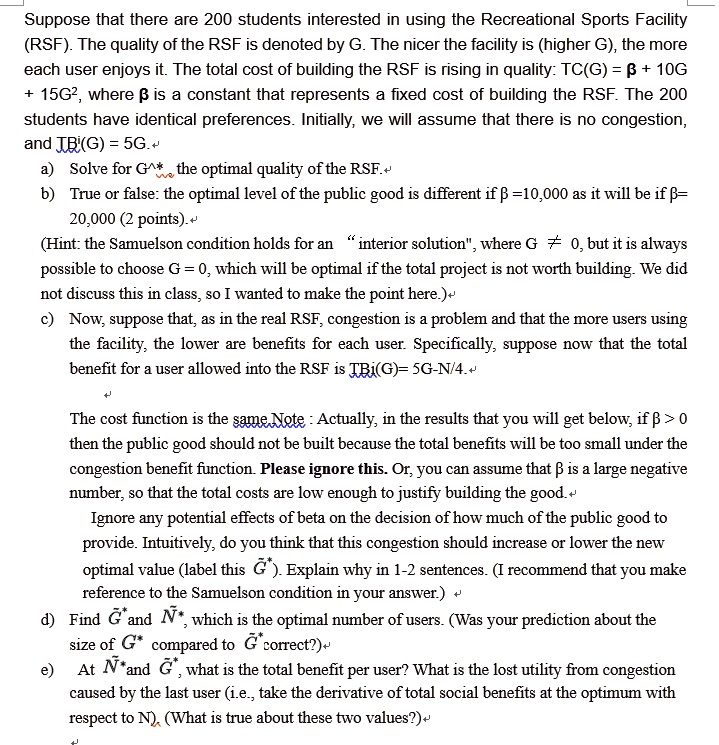
Suppose that there are 200 students interested in using the Recreational Sports Facility (RSF). The quality of the RSF is denoted by G. The nicer the facility is (higher G), the more each user enjoys it. The total cost of building the RSF is rising in quality: TC(G) = 10G + 15G^2, where "c" is a constant that represents a fixed cost of building the RSF. The 200 students have identical preferences. Initially, we will assume that there is no congestion, and TBi(G) = 5G.
a) Solve for G^*, the optimal quality of the RSF.
b) True or false: the optimal level of the public good is different if c = 10,000 as it will be if c = 20,000.
(Hint: the Samuelson condition holds for an "interior solution", where G > 0, but it is always possible to choose G = 0, which will be optimal if the total project is not worth building. We did not discuss this in class, so I wanted to make the point here.)
c) Now, suppose that, as in the real RSF, congestion is a problem and that the more users using the facility, the lower the benefits for each user. Specifically, suppose now that the total benefit for a user allowed into the RSF is TBi(G) = 5G - N/4.
The cost function is the same. Note: Actually, in the results that you will get below, if N > 0 then the public good should not be built because the total benefits will be too small under the congestion benefit function. Please ignore this. Or, you can assume that N is a large negative number, so that the total costs are low enough to justify building the good.
Ignore any potential effects of beta on the decision of how much of the public good to provide. Intuitively, do you think that this congestion should increase or lower the new optimal value (label this G*)? Explain why in 1-2 sentences. (I recommend that you make reference to the Samuelson condition in your answer.)
d) Find G* and N*, which is the optimal number of users. (Was your prediction about the size of G* compared to G* correct?)
e) At N* and G*, what is the total benefit per user? What is the lost utility from congestion caused by the last user (i.e., take the derivative of total social benefits at the optimum with respect to N)? (What is true about these two values)?