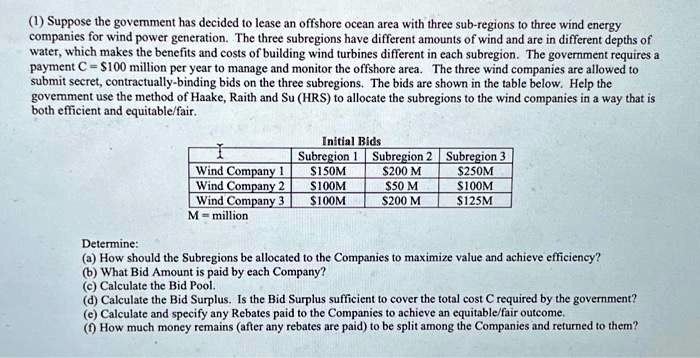
(1) Suppose the government has decided to lease an offshore ocean area with three sub-regions to three wind energy companies for wind power generation. The three subregions have different amounts of wind and are in different depths of water, which makes the benefits and costs of building wind turbines different in each subregion. The government requires a payment C = $100 million per year to manage and monitor the offshore area. The three wind companies are allowed to submit secret, contractually-binding bids on the three subregions. The bids are shown in the table below. Help the government use the method of Haake, Raith and Su (HRS) to allocate the subregions to the wind companies in a way that is both efficient and equitable/fair.
Initial Bids
Subregion 1 Subregion 2 Subregion 3
Wind Company 1 $150M $200 M $250M
Wind Company 2 $100M $50 M $100M
Wind Company 3 $100M $200 M $125M
M = million
Determine:
(a) How should the Subregions be allocated to the Companies to maximize value and achieve efficiency?
(b) What Bid Amount is paid by each Company?
(c) Calculate the Bid Pool.
(e) Calculate and specify any Rebates paid to the Companies to achieve an equitable/fair outcome.
(d) Calculate the Bid Surplus. Is the Bid Surplus sufficient to cover the total cost C required by the government?
(f) How much money remains (after any rebates are paid) to be split among the Companies and returned to them?