In this course, we often use the following "peak hours" formula to calculate the daily
energy output from a PV array, given the solar insolation:
Daily Energy Output =(P_(ramd ) imes S)/(Phi _(AMISG ))
P_(nawd )= Rated Peak Power of PV Panel
S= Insolation (kWh)/(m^(2)-day)
Phi _(MNISG )= Radiative Power Flux at peak sun (W)/(m^(2))
This formula is equivalent to saying that a panel will receive (S)/(Phi _(AM1.5G peak hours of ))
sun per day. In other words, if Boston receives 4kW(h)/(m^(2))/ day, our formula will
assume that our panels will see 4 hours of sun that has an intensity of 1k(W)/(m^(2)).
However, this overestimates the amount of power output from our PV array
because the efficiency of a solar cell decreases at lower illumination levels.
Therefore, we should really account for these lower efficiencies to get a better
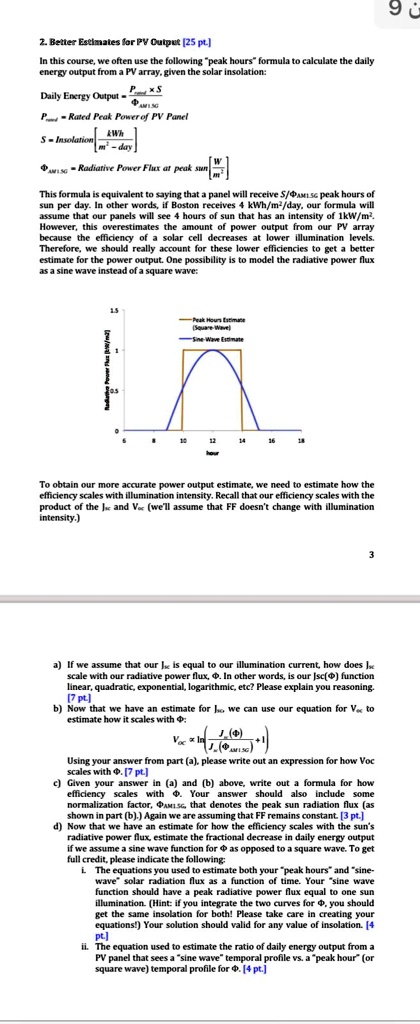
estimate for the power output. One possibility is to model the radiative power flux
as a sine wave instead of a square wave:
To obtain our more accurate power output estimate, we need to estimate how the
efficiency scales with illumination intensity. Recall that our efficiency scales with the
product of the J_(sc) and V_(oC) (we'll assume that FF doesn't change with illumination
intensity.)
a) If we assume that our J_(sc) is equal to our illumination current, how does J_(sc)
scale with our radiative power flux, Phi . In other words, is our Jsc(Phi ) function
linear, quadratic, exponential, logarithmic, etc? Please explain you reasoning.
[7 pt]
b) Now that we have an estimate for J_(sc) we can use our equation for V_(oc) to
estimate how it scales with Phi :
V_(OC)propln((J_(sc)(Phi ))/(J_(sC)(Phi _(AM15C)))+1)
Using your answer from part (a), please write out an expression for how Voc
scales with Phi . [7 pt.]
c) Given your answer in (a) and (b) above, write out a formula for how
efficiency scales with Phi . Your answer should also include some
normalization factor, Phi _(AM1.5G), that denotes the peak sun radiation flux (as
shown in part (b).) Again we are assuming that FF remains constant. [3 pt.]
d) Now that we have an estimate for how the efficiency scales with the sun's
radiative power flux, estimate the fractional decrease in daily energy output
if we assume a sine wave function for Phi as opposed to a square wave. To get
full credit, please indicate the following:
i. The equations you used to estimate both your "peak hours" and "sine-
wave" solar radiation flux as a function of time. Your "sine wave
function should have a peak radiative power flux equal to one sun
illumination. (Hint: if you integrate the two curves for Phi , you should
get the same insolation for both! Please take care in creating your
equations!) Your solution should valid for any value of insolation. [4
pt.]
ii. The equation used to estimate the ratio of daily energy output from a
PV panel that sees a "sine wave" temporal profile vs. a "peak hour" (or
square wave) temporal profile for Phi . [4 pt.]
2.Better Estmates for PV Outpet [25 pt.] In this course, we often use the following peak hours formula to calculate the daily energy output from a PV array, given the solar insolation: PS Daily Energy Output =
P- Rated Peak Powerof PV Panel kWh S=Insolation
This formula is equivalent to saying that a panel will receive S/sc peak hours of sun per day. In other words, if Boston receives 4 kWh/m2/day, our formula will assume that our panels will see 4 hours of sun that has an intensity of 1kW/m2. However, this overestimates the amount of power output from our PV array because the efficiency of a solar cell decreases at lower illumination levels. Therefore, we should really account for these lower efficiencies to get a better estimate for the power output. One possibility is to model the radiative power flux as a sine wave instead of a square wave:
(Square-Weve)
To obtain our more accurate power output estimate, we need to estimate how the efficiency scales with illumination intensity. Recall that our efficiency scales with the product of the Ju and V (we'll assume that FF doesnt change with illumination intensity.)
a If we assume that our J is equal to our illumination current, how does Jx scale with our radiative power flux, . In other words, is our Jsc() function linear, quadratic, exponential, logarithmic, etc? Please explain you reasoning. [7 pt.] b Now that we have an estimate for Jso we can use our equation for V to estimate how it scales with ) Voc In
Using your answer from part (a), please write out an expression for how Voc scales with.[7 pt.] c Given your answer in (a and (b above, write out a formula for how efficiency scales with . Your answer should also include some normalization factor, isc, that denotes the peak sun radiation flux (as a n q d) Now that we have an estimate for how the efficiency scales with the suns radiative power flux, estimate the fractional decrease in daily energy output if we assume a sine wave function for as opposed to a square wave.To get full credit, please indicate the following: iThe equations you used to estimate both your"peak hours" and "sine- wavesolar radiation flux as a function of time. Your sine wave function should have a peak radiative power flux equal to one sun illumination. (Hint: if you integrate the two curves for , you should get the same insolation for both! Please take care in creating your equations!) Your solution should valid for any value of insolation. [4 pt.] ii. The equation used to estimate the ratio of daily energy output from a PV panel that sees a sine wave temporal profile vs. a peak hour (or square wave) temporal profile for . [4 pt.]