Learning Goal:
Resistors are often connected to each other in electric circuits. Finding the
equivalent resistance of combinations of resistors is a common and
important task. Equivalent resistance is defined as the single resistance
that can replace the given combination of resistors in such a manner that
the currents in the rest of the circuit do not change.
Finding the equivalent resistance is relatively straightforward if the circuit
contains only resistors in series and parallel. An example of resistors
connected in series is shown in (Figure 1). For such a connection, the
current is the same for all individual resistors and the total voltage is the
sum of the voltages across the individual resistors.
Figure
< 6 of 6 >
Part D
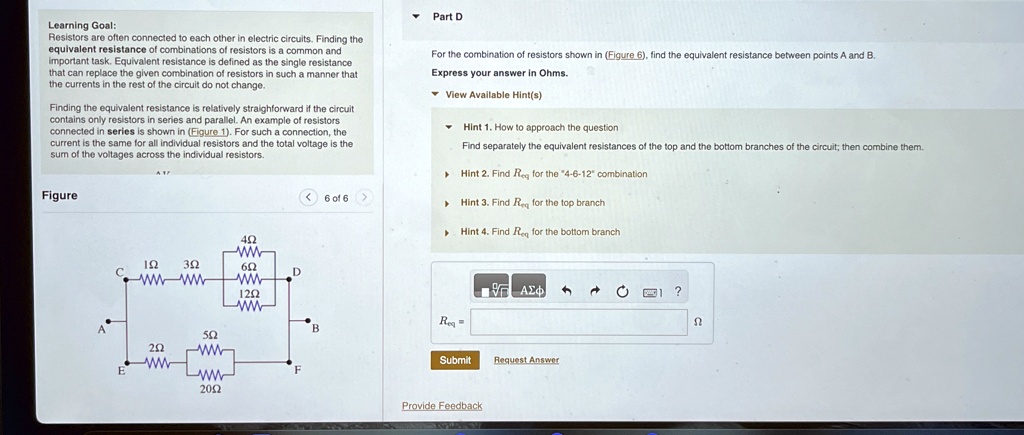
For the combination of resistors shown in (Figure 6), find the equivalent resistance between points A and B.
Express your answer in Ohms.
View Available Hint(s)
Hint 1. How to approach the question
Find separately the equivalent resistances of the top and the bottom branches of the circuit; then combine them.
Hint 2. Find $R_{eq}$ for the "4-6-12" combination
Hint 3. Find $R_{eq}$ for the top branch
Hint 4. Find $R_{eq}$ for the bottom branch
4Ω
ΙΩ 3Ω
www
6Ω
D
12Ω
5Ω
2Ω
E
ww
20Ω
F
ΑΣΦ?
Req =
B
Submit
Request Answer
Provide Feedback
Ω