Ace - AI Tutor
Ask Our Educators
Textbooks
My Library
Flashcards
Scribe - AI Notes
Notes & Exams
Download App
cory harding

cory h.

Divider

Questions asked

BEST MATCH

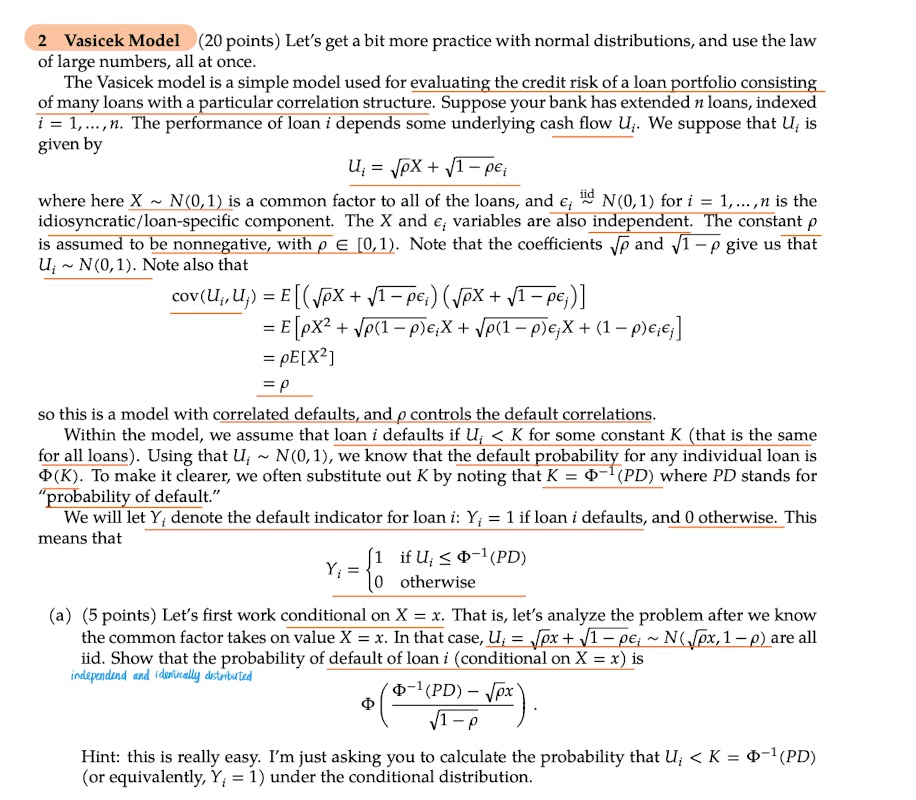
2 Vasicek Model (20 points) Let's get a bit more practice with normal distributions, and use the law of large numbers, all at once. The Vasicek model is a simple model used for evaluating the credit risk of a loan portfolio consisting of many loans with a particular correlation structure. Suppose your bank has extended n loans, indexed i = 1,...,n. The performance of loan i depends some underlying cash flow $U_i$. We suppose that $U_i$ is given by $U_i = \sqrt{p}X + \sqrt{1 - p}e_i$ where here $X \sim N(0, 1)$ is a common factor to all of the loans, and $e_i \stackrel{iid}{\sim} N(0, 1)$ for $i = 1,...,n$ is the idiosyncratic/loan-specific component. The X and $e_i$ variables are also independent. The constant p is assumed to be nonnegative, with $p \in [0, 1)$. Note that the coefficients $\sqrt{p}$ and $\sqrt{1 - p}$ give us that $U_i \sim N(0, 1)$. Note also that $cov(U_i, U_j) = E[(\sqrt{p}X + \sqrt{1 - p}e_i)(\sqrt{p}X + \sqrt{1 - p}e_j)]$ $= E[\rho X^2 + \sqrt{p(1 - p)}e_iX + \sqrt{p(1 - p)}e_jX + (1 - p)e_ie_j]$ $= \rho E[X^2]$ $= \rho$ so this is a model with correlated defaults, and $\rho$ controls the default correlations. Within the model, we assume that loan i defaults if $U_i < K$ for some constant K (that is the same for all loans). Using that $U_i \sim N(0, 1)$, we know that the default probability for any individual loan is $\Phi(K)$. To make it clearer, we often substitute out K by noting that $K = \Phi^{-1}(PD)$ where PD stands for "probability of default." We will let $Y_i$ denote the default indicator for loan i: $Y_i = 1$ if loan i defaults, and 0 otherwise. This means that $Y_i = \begin{cases} 1 & \text{if } U_i \le \Phi^{-1}(PD) \\ 0 & \text{otherwise} \end{cases}$ (a) (5 points) Let's first work conditional on $X = x$. That is, let's analyze the problem after we know the common factor takes on value $X = x$. In that case, $U_i = \sqrt{p}x + \sqrt{1 - p}e_i \sim N(\sqrt{p}x, 1 - p)$ are all iid. Show that the probability of default of loan i (conditional on $X = x$) is $\Phi(\frac{\Phi^{-1}(PD) - \sqrt{p}x}{\sqrt{1 - p}})$. Hint: this is really easy. I'm just asking you to calculate the probability that $U_i < K = \Phi^{-1}(PD)$ (or equivalently, $Y_i = 1$) under the conditional distribution.
View Answer
divider
BEST MATCH

what blood type if clumping in anti b but not in anti A and anti

View Answer
divider
BEST MATCH

The Lottery Hypothesis resolves the Paradox of Sex by showing that when there is environmental variation, sexual reproduction will always be a more successful strategy than asexual reproduction sexual reproduction can decrease the accumulation of harmful genetic mutations in a population sexual reproducers may produce offspring with higher fitness than asexual reproducers when the environment is variable sexual reproduction is favored when there is parasitism

View Answer
divider
BEST MATCH

Exercise 1 Statics and linear constraints [30 pts]. Consider the academic system shown in Figure 1. Each of the four masses i, i = 1,..., 4, has two degrees-of-freedom, ($u_{xi}$, $u_{yi}$), displacements in the directions x and y, respectively. All springs have the same stiffness k = 1. Assume infinitely small displacements. The second degree-of-freedom, labelled 2, is subject to 3 f3 f4 4 XX mm 1 2 Figure 1: A simple 4-degree-of-freedom system. two constraints (not sketched) in the form (1) $u_{2x}$ = 1 and $u_{2y}$ = 2$u_{2x}$. Also, it is assumed that $f_3$ = ($f_{3x}$, $f_{3y}$) = (0, 1) and $f_4$=($f_{4x}$, $f_{4y}$) = (1, 0). 1. Express the above equations in the following matrix form Kx = f Ax = b (1) (2) where x = ($u_{x1}$, $u_{y1}$,..., $u_{x4}$, $u_{y4}$)$^T$; K is the stiffness matrix; f collects all forces acting on the system. Equation (1) stems from static equilibrium while Equation (2) enforces the considered constraints. Carefully identify the unknowns of the problem and provide the full expressions for K, f, A and b. 2. Solve and sketch the system in its current state. 3. Provide a variation of the system in Figure 1 which would have no solution. 4. Provide a variation of the system in Figure 1 which would have infinitely many solutions.

View Answer
divider
BEST MATCH

2. (25 points) Solutions to banded systems: (a) (14 points) Write down the Gaussian Elimination algorithm to solve a matrix system, $Ax = b$, where A is a penta-diagonal matrix. Note that a penta-diagonal matrix has non-zero entries only on the main diagonal, 2 super-diagonals and 2 sub-diagonals. Make sure the operations on zero entries are leveraged to achieve computational gain. (b) (7 points) What is the computational cost for the above algorithm? (No need the calculate the cost for the backward substitution part of the solution procedure). (c) (4 points) Knowing the computational costs to perform Gaussian Elimination on (i) a tridiagonal system, whose bandwidth $n_b = 2$ (1 main diagonal + 1 super/sub-diagonal), (ii) a penta-diagonal system, whose bandwidth $n_b = 3$, from the solution to (b), and (iii) a full matrix, whose bandwidth $n_b = n$, make an estimate for the computational cost to perform Gaussian Elimination for a matrix with bandwidth $n_b$.

View Answer
divider
BEST MATCH

4. Assuming $\phi$ to be a scalar, and a two-dimensional del operator: $\nabla = \frac{\partial}{\partial x}i + \frac{\partial}{\partial y}j$, evaluate the following quantities: $(\nabla \phi) \times (\nabla \phi)$

View Answer
divider
BEST MATCH

Priority Encoder module priority(input [3:0] a, output reg [3:0] y); always @(*) if (a[3]) y = 4'b1000; else if (a[2]) y = 4'b0100; else if (a[1]) y = 4'b0010; else if (a[0]) y = 4'b0001; endmodule

View Answer
divider
BEST MATCH

When interpreting a correlation, should you focus more on the r-value or the p-value? Explain why.

View Answer
divider
BEST MATCH

5. Water flows through a cylindrical pipe of internal radius 8 cm at a rate of 32 cm/sec. (a) Calculate, in terms of $\pi$, the rate of flow of water from the pipe (b) How long will it take to fill a rectangular tank with dimensions 1.5 m \times 2 m \times 1 m?

View Answer
divider
BEST MATCH

Write the exponential function represented by the given table of values. Show your solutions on the space provided. (10 pts.) 1. $x$ $f(x)$ -2 $\frac{25}{16}$ -1 $\frac{5}{4}$ 0 1 1 $\frac{4}{5}$ 2 $\frac{16}{25}$ 2. $x$ $f(x)$ -1 6 0 1 1 $\frac{3}{2}$ 2 $\frac{3}{4}$ 3 $\frac{3}{8}$

View Answer
divider