Texts: Blanks are: 3 trillion higher, 3 trillion lower, 1 trillion higher, 1 trillion lower a contraction, an expansion 20, 30, 40 the same, higher, lower, increase, decrease increase, decrease SRAS, AD, LRAS, left, right increase, decrease increase, decrease increase, decrease, SRAS, AD, LRAS rightward, leftward high inflation, low inflation high inflation, low inflation Please answer all blanks clearly. Sorry for the long question, thank you very much.
4. The long-run effect of Federal Reserve action (or inaction) in the AD-AS model
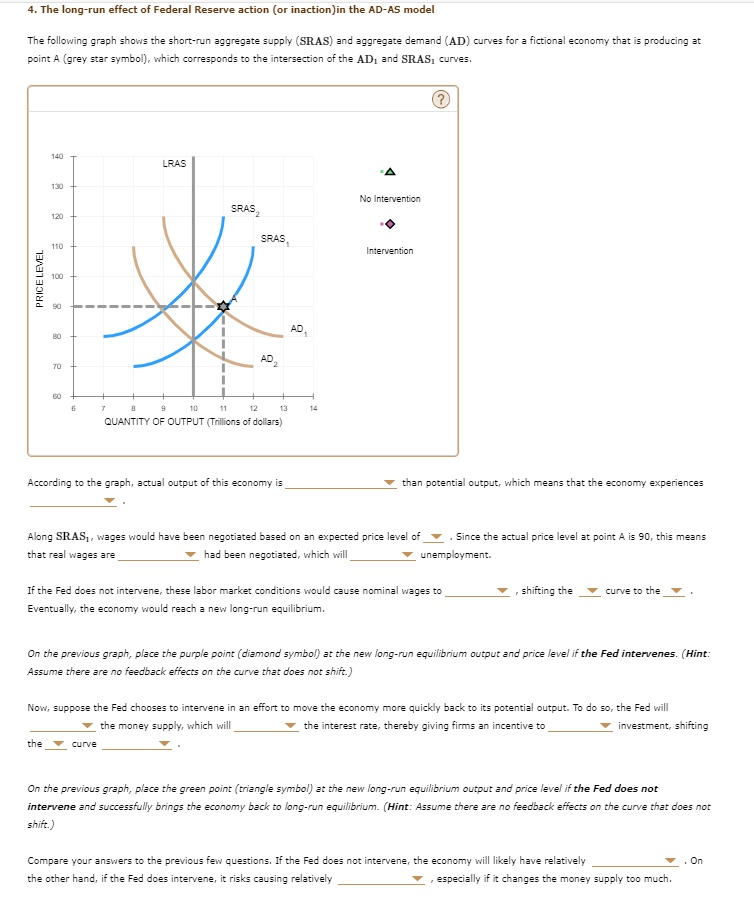
The following graph shows the short-run aggregate supply (SRAS) and aggregate demand (AD) curves for a fictional economy that is producing at point A (grey star symbol), which corresponds to the intersection of the AD and SRAS curves.
?
140
LRAS
130
SRAS,
No Intervention
120
110 PRICE LEVEL 100 90
SRAS,
Intervention
80
70
AD,
60 6
8
9
10
11
12
13 QUANTITY OF OUTPUT (Trillions of dollars)
14
According to the graph, actual output of this economy is lower than potential output, which means that the economy experiences a contraction.
Along SRAS, wages would have been negotiated based on an expected price level of V. Since the actual price level at point A is 90, this means that real wages are higher than what had been negotiated, which will increase unemployment.
If the Fed does not intervene, these labor market conditions would cause nominal wages to decrease. Eventually, the economy would reach a new long-run equilibrium by shifting the curve to the right.
On the previous graph, place the purple point (diamond symbol) at the new long-run equilibrium output and price level if the Fed intervenes. (Hint: Assume there are no feedback effects on the curve that does not shift.)
Now, suppose the Fed chooses to intervene in an effort to move the economy more quickly back to its potential output. To do so, the Fed will increase the money supply, which will shift the AD curve to the right. This will decrease the interest rate, thereby giving firms an incentive to increase investment, shifting the SRAS curve to the right.
On the previous graph, place the green point (triangle symbol) at the new long-run equilibrium output and price level if the Fed does not intervene and successfully brings the economy back to long-run equilibrium. (Hint: Assume there are no feedback effects on the curve that does not shift.)
Compare your answers to the previous few questions. If the Fed does not intervene, the economy will likely have relatively low inflation. On the other hand, if the Fed does intervene, it risks causing relatively high inflation, especially if it changes the money supply too much.