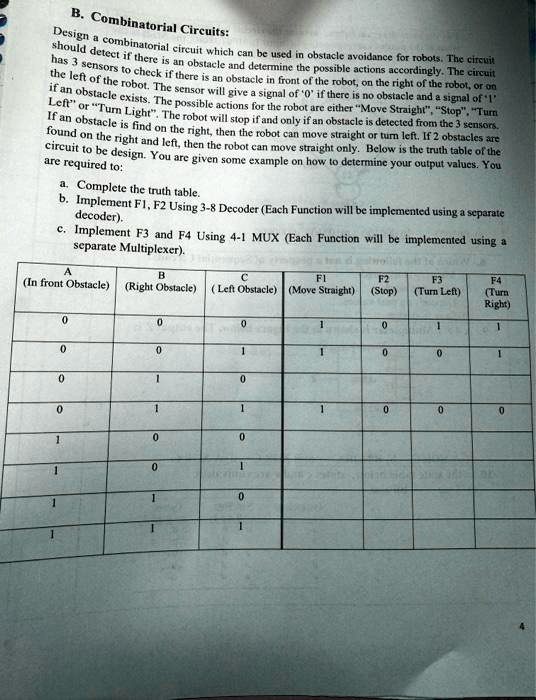
B. Combinatorial Circuits:
Design a combinatorial circuit which can be used in obstacle avoidance for robots. The circuit
should detect if there is an obstacle and determine the possible actions accordingly. The circuit
has 3 sensors to check if there is an obstacle in front of the robot, on the right of the robot, or on
the left of the robot. The sensor will give a signal of '0' if there is no obstacle and a signal of '1'
if an obstacle exists. The possible actions for the robot are either "Move Straight", "Stop", "Turn
Left" or "Turn Light". The robot will stop if and only if an obstacle is detected from the 3 sensors.
If an obstacle is find on the right, then the robot can move straight or turn left. If 2 obstacles are
found on the right and left, then the robot can move straight only. Below is the truth table of the
circuit to be design. You are given some example on how to determine your output values. You
are required to:
a. Complete the truth table.
b. Implement F1, F2 Using 3-8 Decoder (Each Function will be implemented using a separate
decoder).
c. Implement F3 and F4 Using 4-1 MUX (Each Function will be implemented using a
separate Multiplexer).
A
B
C
F1
F2
F3
F4
(In front Obstacle) (Right Obstacle) (Left Obstacle) (Move Straight) (Stop) (Turn Left) (Turn
Right)
0
0
0
1
0
1
1
0
0
1
1
0
0
1
0
1
0
0
1
1
1
0
0
0
1
0
0
1
0
1
1
0
1
1
1