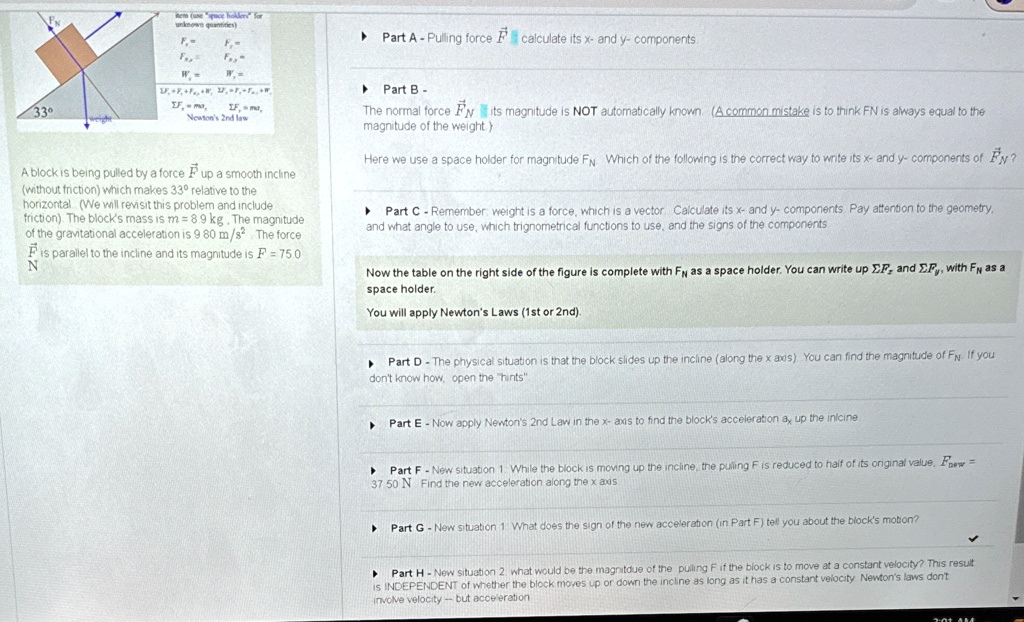
33<sup>o</sup>
F
F<sub>N</sub>
F
F<sub>x</sub>
F<sub>y</sub>
W
W<sub>x</sub>
W<sub>y</sub>
ΣF<sub>x</sub>
ΣF<sub>y</sub>
ΣF<sub>x</sub> = ma<sub>x</sub>
ΣF<sub>y</sub> = ma<sub>y</sub>
Newton's 2nd law
A block is being pulled by a force **F** up a smooth incline
(without friction) which makes 33<sup>o</sup> relative to the
horizontal (We will revisit this problem and include
friction). The block's mass is m = 8.9 kg. The magnitude
of the gravitational acceleration is 9.80 m/s<sup>2</sup>. The force
**F** is parallel to the incline and its magnitude is F = 75.0
N
▸ Part A - Pulling force **F** calculate its x- and y- components.
▸ Part B -
The normal force **F<sub>N</sub>** its magnitude is NOT automatically known. (A common mistake is to think F<sub>N</sub> is always equal to the
magnitude of the weight)
Here we use a space holder for magnitude F<sub>N</sub>. Which of the following is the correct way to write its x- and y-components of **F<sub>N</sub>**?
▸ Part C - Remember: weight is a force, which is a vector. Calculate its x and y components. Pay attention to the geometry,
and what angle to use, which trignometrical functions to use, and the signs of the components
Now the table on the right side of the figure is complete with F<sub>N</sub> as a space holder. You can write up ΣF<sub>x</sub> and ΣF<sub>y</sub> with F<sub>N</sub> as a
space holder.
You will apply Newton's Laws (1st or 2nd).
▸ Part D - The physical situation is that the block slides up the incline (along the x axis) You can find the magnitude of F<sub>N</sub>. If you
don't know how, open the "hints"
▸ Part E - Now apply Newton's 2nd Law in the x- axis to find the block's acceleration a<sub>x</sub> up the inlcine
▸ Part F - New situation 1. While the block is moving up the incline, the pulling F is reduced to half of its original value, F<sub>new</sub> =
37.50 N Find the new acceleration along the x axis
▸ Part G - New situation 1. What does the sign of the new acceleration (in Part F) tell you about the block's motion?
▸ Part H - New situation 2. what would be the magnitdue of the pulling F if the block is to move at a constant velocity? This result
is INDEPENDENT of whether the block moves up or down the incline as long as it has a constant velocity Newton's laws don't
involve velocity but acceleration