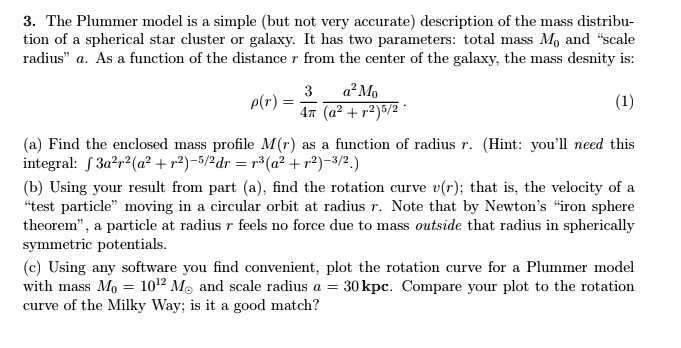
3. The Plummer model is a simple (but not very accurate) description of the mass distribu-\ntion of a spherical star cluster or galaxy. It has two parameters: total mass $M_0$ and \"scale\nradius\" $a$. As a function of the distance $r$ from the center of the galaxy, the mass desnity is:\n\n$ \rho(r) = \frac{3}{4\pi} \frac{a^2 M_0}{(a^2 + r^2)^{5/2}} $.\n(1)\n(a) Find the enclosed mass profile $M(r)$ as a function of radius $r$. (Hint: you'll need this\nintegral: $\int 3a^2r^2(a^2 + r^2)^{-5/2}dr = r^3(a^2 + r^2)^{-3/2}$.)\n(b) Using your result from part (a), find the rotation curve $v(r)$; that is, the velocity of a\n\"test particle\" moving in a circular orbit at radius $r$. Note that by Newton's \"iron sphere\ntheorem\", a particle at radius $r$ feels no force due to mass outside that radius in spherically\nsymmetric potentials.\n(c) Using any software you find convenient, plot the rotation curve for a Plummer model\nwith mass $M_0 = 10^{12} M_\odot$ and scale radius $a = 30 \text{ kpc}$. Compare your plot to the rotation\ncurve of the Milky Way; is it a good match?