Ace - AI Tutor
Ask Our Educators
Textbooks
My Library
Flashcards
Scribe - AI Notes
Notes & Exams
Download App
courtney cameron

courtney c.

Divider

Questions asked

BEST MATCH

Question 3 1 pts During your ride upward to the 20th floor, the rider was slowing down from floor [Select] through [Select] . During this part of the trip, the normal force [Select] the force of gravity.

View Answer
divider
BEST MATCH

3. Assume a waveguide is formed by a piece of dielectric with thickness d and two perfect electric conductors as the upper and lower boundaries. A schematic of the waveguide structure is shown in the figure below. The waveguide extends into infinity on both sides in the z direction. Assume the waveguide modes propagate along x axis. Please follow the steps below to solve for TM modes for this waveguide. (30 pts in total) y d/2 PEC ?, ? -d/2 PEC X 1) For TM modes, the magnetic field only has transverse field components (i.e., vertical to the propagation direction). In this case, it is Hz. Please write the wave equation for Hz in the waveguide dielectric layer? (4 pts) 2) Similar to the symmetric dielectric slab waveguide structures, this waveguide support TM even modes and odd modes. Assume the propagation constant is $\beta$, please write the wave function for magnetic field Hz for even and odd modes. (8 pts) 3) Please calculate the electric field components for both even and odd TM modes from the corresponding magnetic field profiles Hz? (8 pts) 4) Please apply boundary conditions (4 pts) to obtain the dispersion relation $\beta$-? (6 pt)

View Answer
divider
BEST MATCH

What steps would you need to do before using a 100x objective lens and why? (1 pt)

View Answer
divider
BEST MATCH

Question 2 Systemic anatomy Pseudostratified ciliated columnar epithelium is commonly found in this organ system. Pancreas belong to the endocrine system and ______ Transitional epithelium is commonly found in the ______ The largest organ in the body belongs to this organ system ______ The circulatory system is a combination of cardiovascular system and ______ 10 pts

View Answer
divider
BEST MATCH

1. A ____ can be written in the form $f(x) = \frac{p(x)}{q(x)}$, where $p(x)$ and $q(x)$ are polynomials and $q(x)$ is not a zero polynomial that is, $q(x) \neq 0$. 2. Rational functions can be represented through _____ 3. The zeroes of a rational function is the set of all real numbers that are not zeroes of its _____. When the numbers from the domain are substituted in the function the set of resulting values is called the _____

View Answer
divider
BEST MATCH

Solve: $1 + \cos 2\theta = -\cos \theta$

View Answer
divider
BEST MATCH

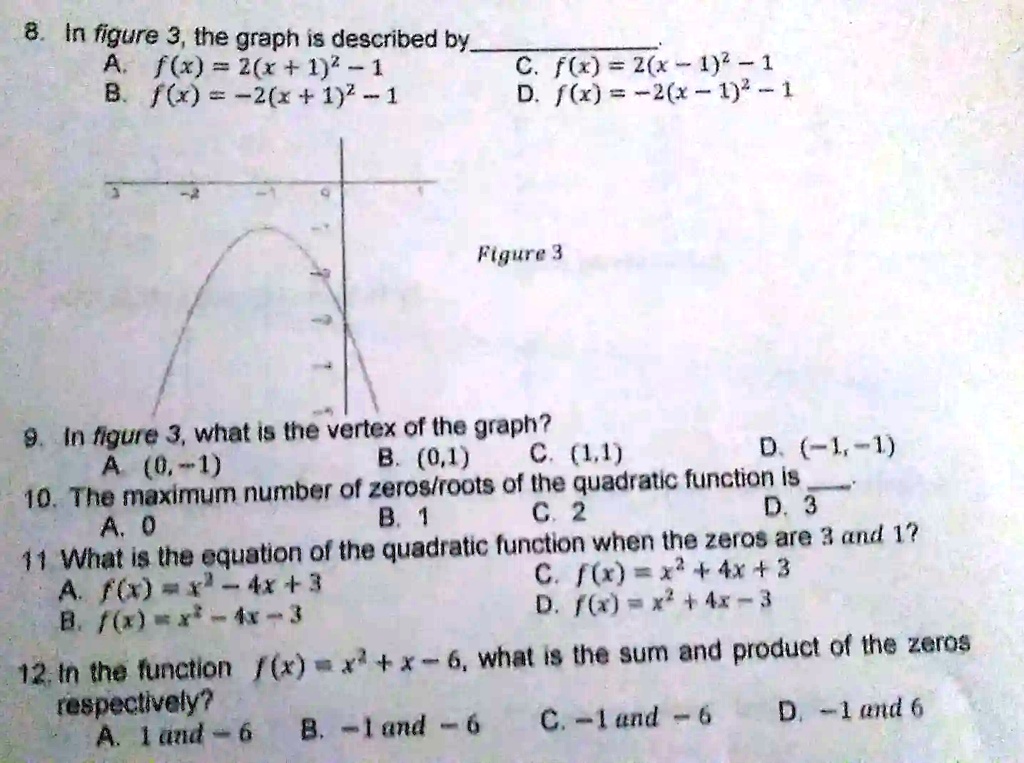
8. In figure 3, the graph is described by_ A. $f(x) = 2(x+1)^2 - 1$ B. $f(x) = -2(x+1)^2 - 1$ C. $f(x) = 2(x-1)^2 - 1$ D. $f(x) = -2(x-1)^2 - 1$ 9. In figure 3, what is the vertex of the graph? A. $(0, -1)$ B. $(0, 1)$ C. $(1, 1)$ D. $(-1, -1)$ 10. The maximum number of zeros/roots of the quadratic function is_ A. 0 B. 1 C. 2 D. 3 11 What is the equation of the quadratic function when the zeros are 3 and 1? A. $f(x) = x^2 - 4x + 3$ B. $f(x) = x^2 - 4x - 3$ C. $f(x) = x^2 + 4x + 3$ D. $f(x) = x^2 + 4x - 3$ 12. In the function $f(x) = x^2 + x - 6$, what is the sum and product of the zeros respectively? A. 1 and -6 B. -1 and -6 C. -1 and -6 D. -1 and 6
View Answer
divider
BEST MATCH

Predict the products of each reaction below. Indicate regiochemistry and stereochemistry when relevant. KMnO$_4$

View Answer
divider
BEST MATCH

30 Question (1.5 Points) A regression between medical gloves length and patient height (independent variable) for 33 patients resulted in the following regression equation: $y^ = 10.9 + 0.23 x$. One patient in the sample was 73 inches tall with a glove length of 29 cm. What is the residual for this patient? Enter your answer

View Answer
divider
BEST MATCH

Below is a graph showing the change in a neuron membrane potential as it moves from the resting potential to an action potential and then back to the resting potential. Click on the section of the graph where the main ion flow is K+ leaving the neuron due to both the electrostatic gradient and the K+ concentration gradient.

View Answer
divider