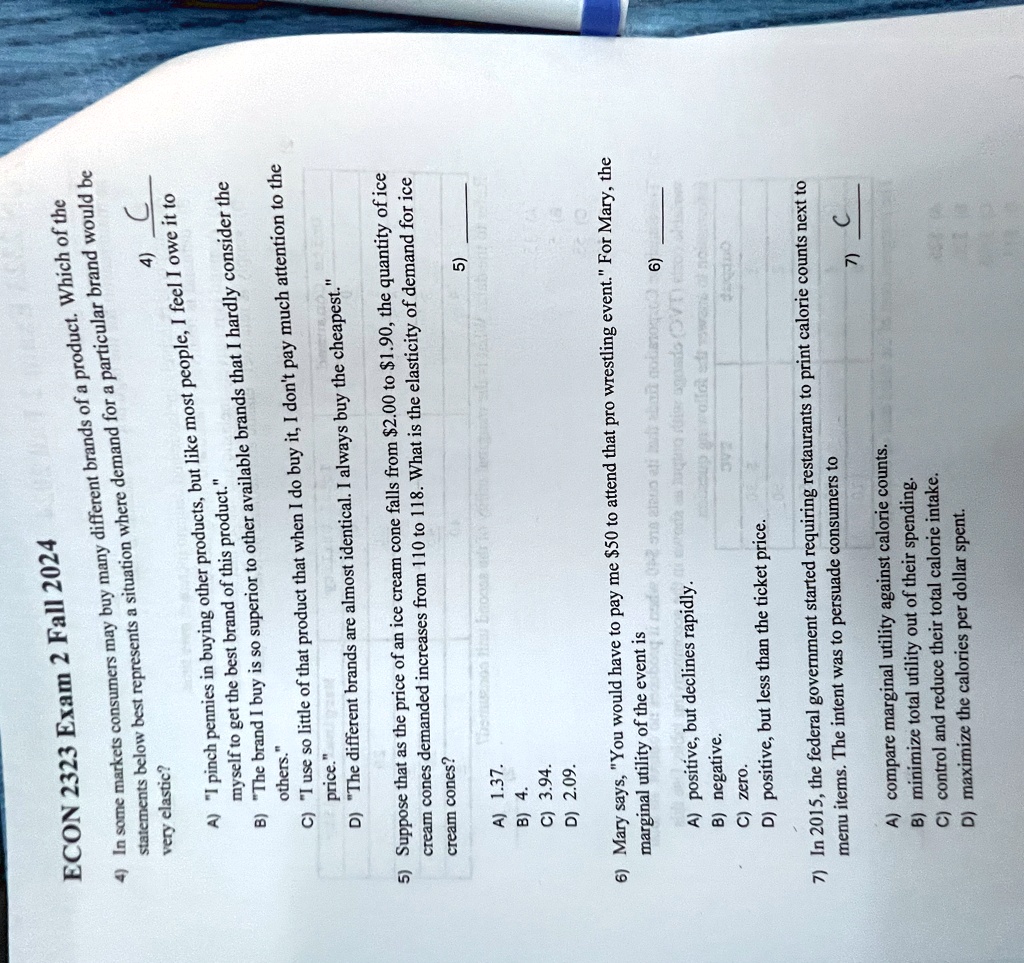
4) In some markets consumers may buy many different brands of a product. Which of the
statements below best represents a situation where demand for a particular brand would be
very elastic?
4)
C
A) "I pinch pennies in buying other products, but like most people, I feel I owe it to
myself to get the best brand of this product."
B) "The brand I buy is so superior to other available brands that I hardly consider the
others."
C) "I use so little of that product that when I do buy it, I don't pay much attention to the
price."
D) "The different brands are almost identical. I always buy the cheapest."
5) Suppose that as the price of an ice cream cone falls from $2.00 to $1.90, the quantity of ice
cream cones demanded increases from 110 to 118. What is the elasticity of demand for ice
cream cones?
A) 1.37.
B) 4.
C) 3.94.
D) 2.09.
5)
6) Mary says, "You would have to pay me $50 to attend that pro wrestling event." For Mary, the
marginal utility of the event is
A) positive, but declines rapidly.
B) negative.
C) zero.
D) positive, but less than the ticket price.
3V2
6)
7) In 2015, the federal government started requiring restaurants to print calorie counts next to
menu items. The intent was to persuade consumers to
A) compare marginal utility against calorie counts.
B) minimize total utility out of their spending.
C) control and reduce their total calorie intake.
D) maximize the calories per dollar spent.
7) C