Question 1 of 24
Resources
Al Tutor (1)
Submit Answer
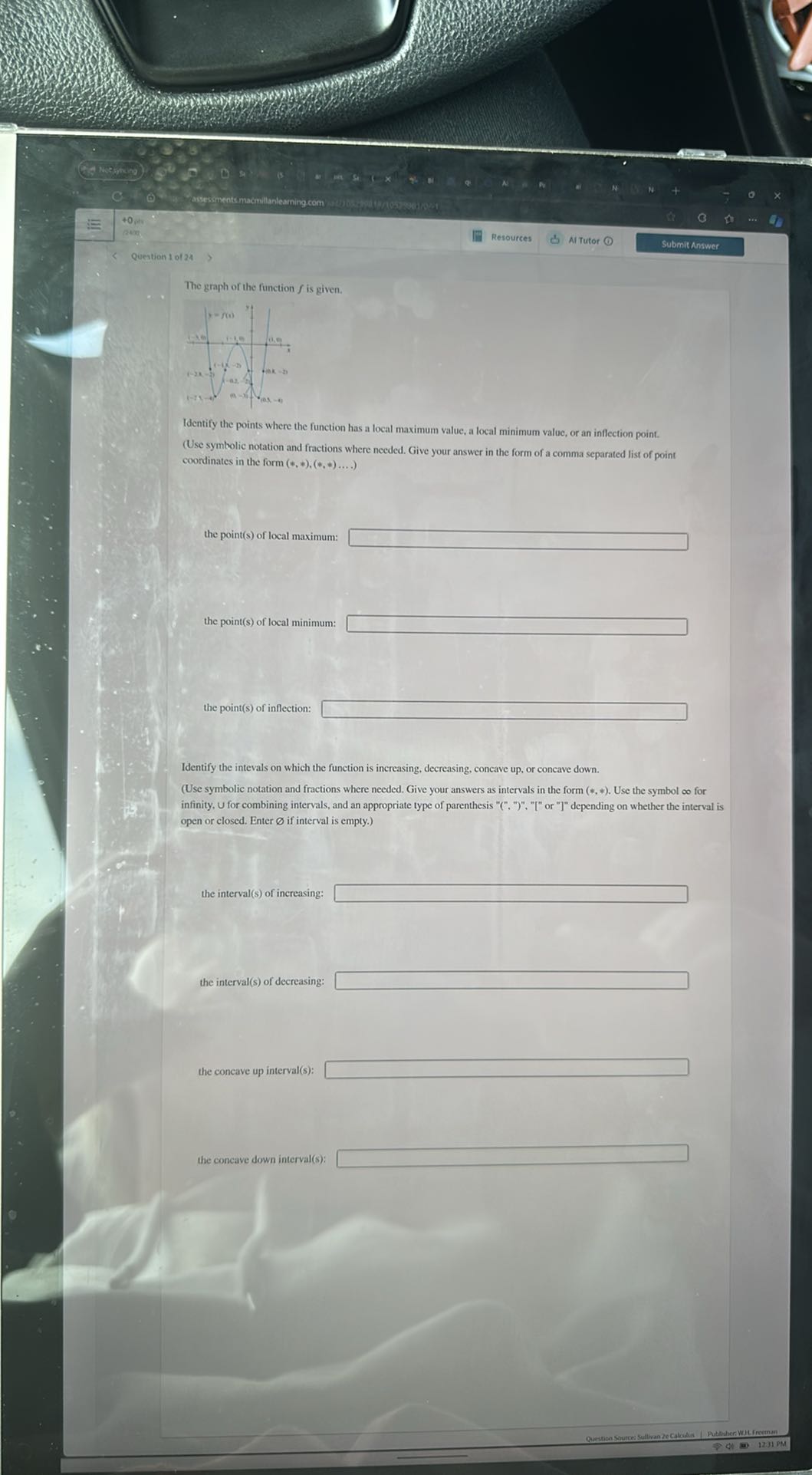
The graph of the function \( f \) is given.
Identify the points where the function has a local maximum value, a local minimum value, or an inflection point. (Use symbolic notation and fractions where needed. Give your answer in the form of a comma separated list of point coordinates in the form \( (*, *),(*, *) \ldots \).
the point(s) of local maximum: \( \square \)
the point(s) of local minimum: \( \square \)
the point(s) of inflection: \( \square \)
Identify the intevals on which the function is increasing, decreasing, concave up, or concave down.
(Use symbolic notation and fractions where needed. Give your answers as intervals in the form ( \( *, *) \). Use the symbol \( \infty \) for infinity, \( U \) for combining intervals, and an appropriate type of parenthesis "(". ")". "[" or "]" depending on whether the interval is open or closed. Enter \( \varnothing \) if interval is empty.)
the interval(s) of increasing: \( \square \)
the interval(s) of decreasing: \( \square \)
the concave up interval(s): \( \square \)
the concave down interval(s): \( \square \)