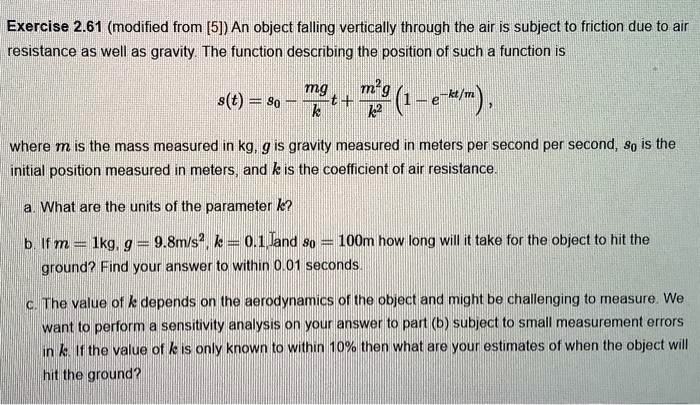
Exercise 2.61 (modified from [5]) An object falling vertically through the air is subject to friction due to air resistance as well as gravity. The function describing the position of such a function is
\(s(t) = s_0 - \frac{mg}{k}t + \frac{m^2g}{k^2}(1 - e^{-kt/m})\),
where \(m\) is the mass measured in kg, \(g\) is gravity measured in meters per second per second, \(s_0\) is the initial position measured in meters, and \(k\) is the coefficient of air resistance.
a. What are the units of the parameter \(k\)?
b. If \(m = 1kg\), \(g = 9.8m/s^2\), \(k = 0.1\), and \(s_0 = 100m\) how long will it take for the object to hit the ground? Find your answer to within 0.01 seconds.
c. The value of \(k\) depends on the aerodynamics of the object and might be challenging to measure. We want to perform a sensitivity analysis on your answer to part (b) subject to small measurement errors in \(k\). If the value of \(k\) is only known to within 10\% then what are your estimates of when the object will hit the ground?