1. Find E1 through E5
2. Find v1 through v5
3. Find h1 through h5
4. Find F_friction, distance, W_net, W_friction, W_gravity, and W_normal between position 3 and 4.
2
h
5
3
a
R
hsi 30
60o
30
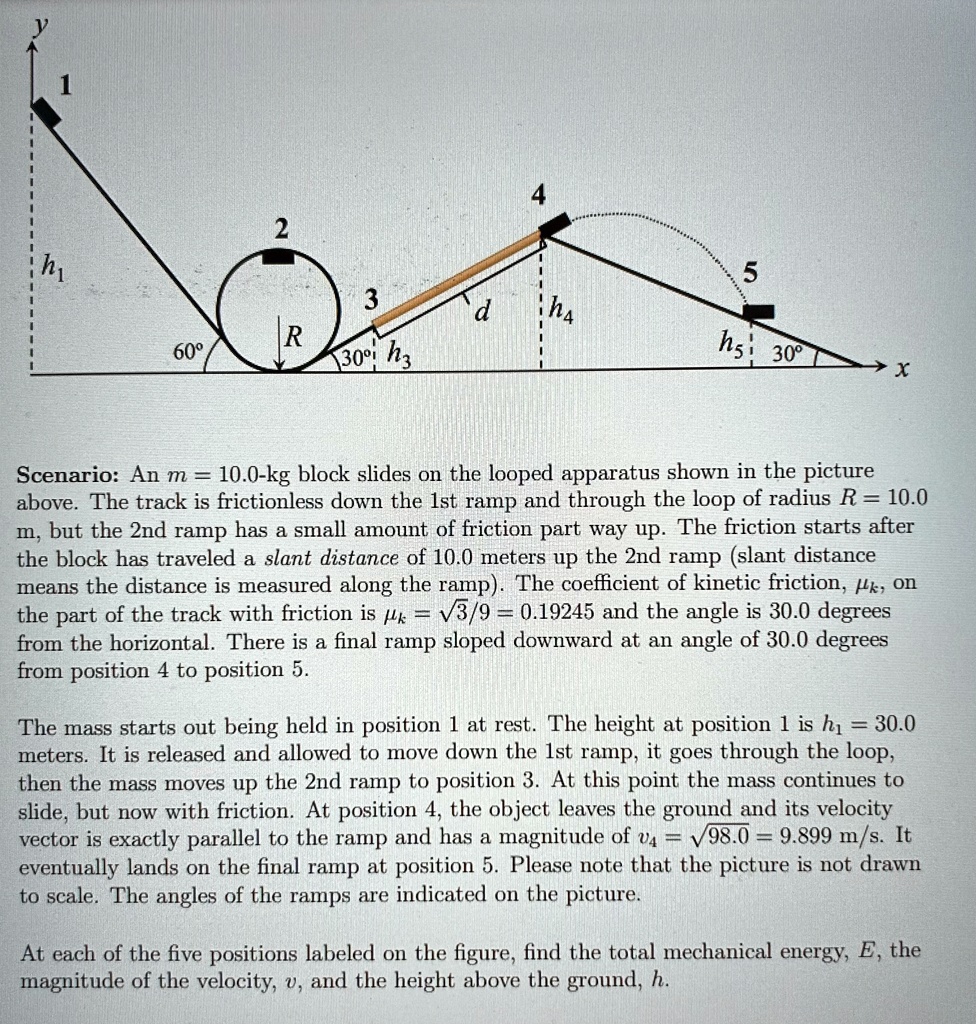
Scenario: An m=10.0-kg block slides on the looped apparatus shown in the picture above. The track is frictionless down the 1st ramp and through the loop of radius R=10.0 m, but the 2nd ramp has a small amount of friction partway up. The friction starts after the block has traveled a slant distance of 10.0 meters up the 2nd ramp (slant distance means the distance is measured along the ramp from the horizontal. There is a final ramp sloped downward at an angle of 30.0 degrees from position 4 to position 5.
The mass starts out being held in position 1 at rest. The height at position 1 is h=30.0 meters. It is released and allowed to move down the 1st ramp, it goes through the loop, then the mass moves up the 2nd ramp to position 3. At this point, the mass continues to slide, but now with friction. At position 4, the object leaves the ground and its velocity vector is exactly parallel to the ramp and has a magnitude of 4=V98.0=9.899 m/s. It eventually lands on the final ramp at position 5. Please note that the picture is not drawn to scale. The angles of the ramps are indicated on the picture.
At each of the five positions labeled on the figure find the total mechanical energy, E, the magnitude of the velocity, v, and the height above the ground, h.