Question 1
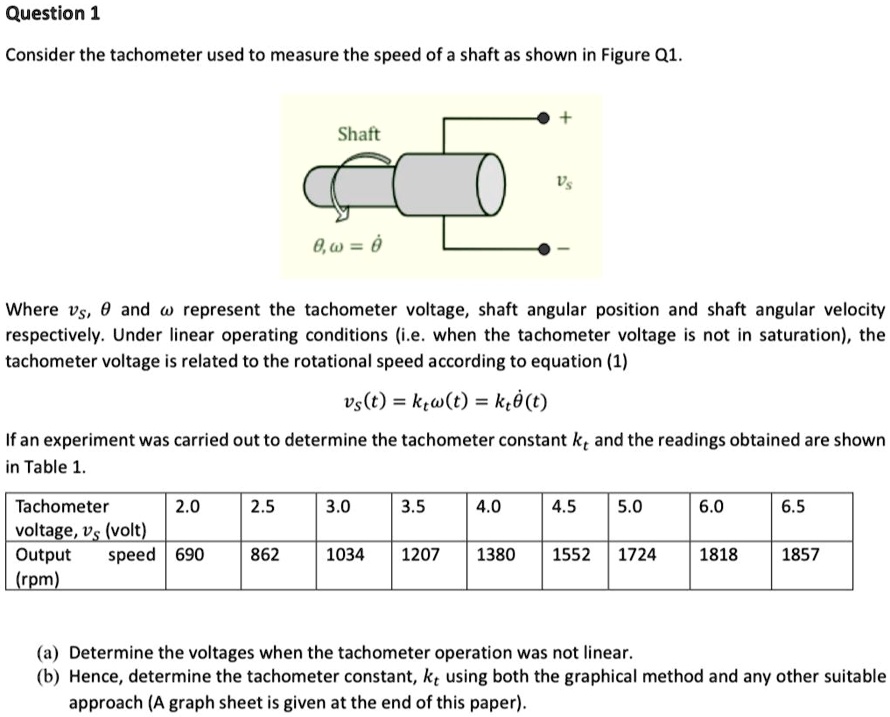
Consider the tachometer used to measure the speed of a shaft as shown in Figure Q1.
Shaft
$\theta$, $\omega = \dot{\theta}$
+\$v_s$
Where $v_s$, $\theta$ and $\omega$ represent the tachometer voltage, shaft angular position and shaft angular velocity
respectively. Under linear operating conditions (i.e. when the tachometer voltage is not in saturation), the
tachometer voltage is related to the rotational speed according to equation (1)
$v_s(t) = k_t\omega(t) = k_t\dot{\theta}(t)$
If an experiment was carried out to determine the tachometer constant $k_t$ and the readings obtained are shown
in Table 1.
Tachometer
2.0
2.5
3.0
3.5
4.0
4.5
5.0
6.0
6.5
voltage, $v_s$ (volt)
Output speed 690 862
(rpm)
1034 1207 1380 1552 1724
1818
1857
(a) Determine the voltages when the tachometer operation was not linear.
(b) Hence, determine the tachometer constant, $k_t$ using both the graphical method and any other suitable
approach (A graph sheet is given at the end of this paper).