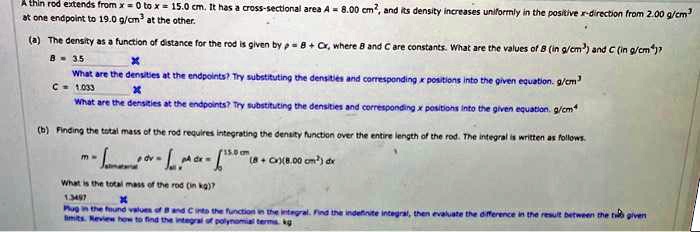
A thin rod extends from x = 0 to x = 15.0 cm. It has a cross-sectional area A = 8.00 cm², and its density increases uniformly in the positive x-direction from 2.00 g/cm³ at one endpoint to 19.0 g/cm³ at the other.
(a) The density as a function of distance for the rod is given by $\rho = B + Cx$, where B and C are constants. What are the values of B (in g/cm³) and C (in g/cm³)
B = 3.5
What are the densities at the endpoints? Try substituting the densities and corresponding x positions into the given equation. g/cm³
C = 1.033
What are the densities at the endpoints? Try substituting the densities and corresponding x positions into the given equation. g/cm?
(b) Finding the total mass of the rod requires integrating the density function over the entire length of the rod. The integral is written as follows.
$m = \int_{xmin}^{xmax} \rho \,dV = \int_{0}^{15.0 \text{cm}} \rho A \,dx = \int_{0}^{15.0 \text{cm}} (B + Cx)(8.00 \text{cm}^2) \,dx$
What is the total mass of the rod (in kg)?
1.3497
Plug in the found values of B and C into the function in the integral. Find the indefinite integral, then evaluate the difference in the result between the two given limits. Review how to find the integral of polynomial terms. kg