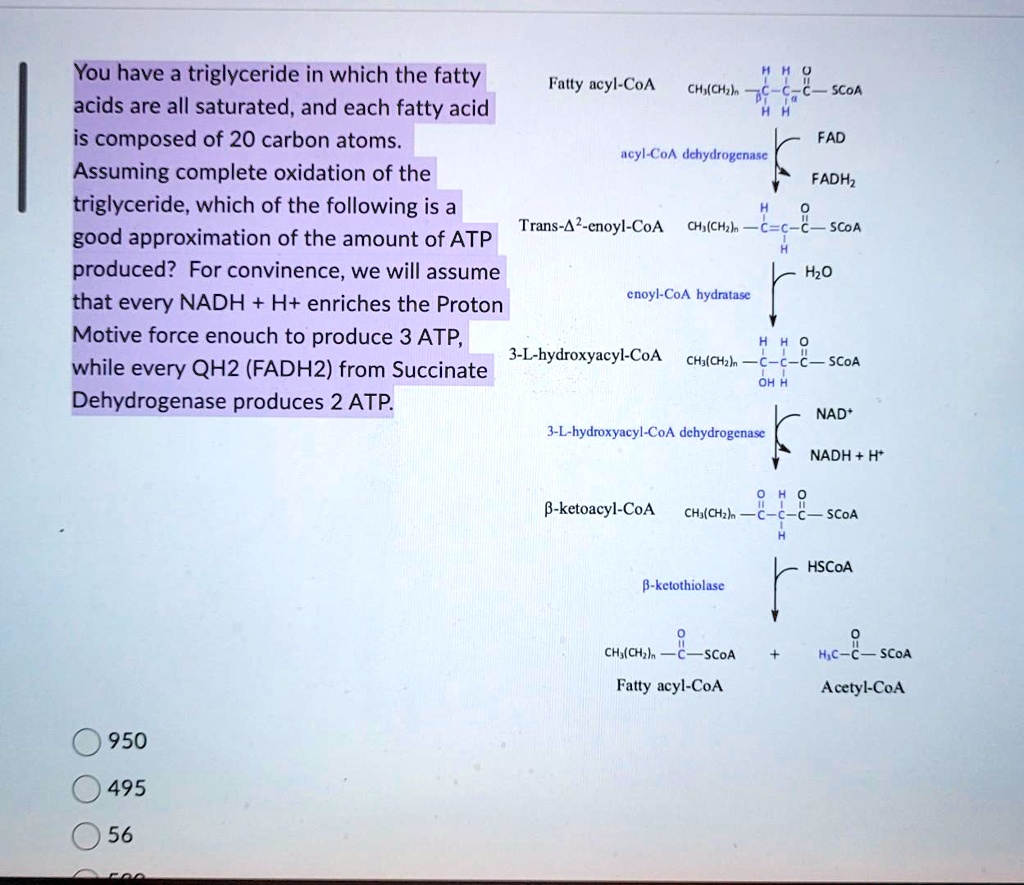
You have a triglyceride in which the fatty
acids are all saturated, and each fatty acid
is composed of 20 carbon atoms.
Assuming complete oxidation of the
triglyceride, which of the following is a
good approximation of the amount of ATP
produced? For convinence, we will assume
that every NADH + H+ enriches the Proton
Motive force enouch to produce 3 ATP,
while every QH2 (FADH2) from Succinate
Dehydrogenase produces 2 ATP.
950
495
56
HO
Fatty acyl-CoA
CH$_3$(CH$_2$)$_n$-C-C-C-SCoA
HH
FAD
FADH$_2$
acyl-CoA dehydrogenase
Trans-A$^2$-enoyl-CoA CH$_3$(CH$_2$)$_n$-
H
Cc-SCoA
H$_2$O
enoyl-CoA hydratase
3-L-hydroxyacyl-CoA CH$_3$(CH$_2$)$_n$-
HHO
SCoA
OH H
NAD$^+$
NADH + H$^+$
3-L-hydroxyacyl-CoA dehydrogenase
\beta-ketoacyl-CoA CH$_3$(CH$_2$)$_n$-
SCoA
\beta-ketothiolase
HSCoA
CH$_3$(CH$_2$)$_n$-
C-SCoA
+
H$_3$C-C-SCoA
Fatty acyl-CoA
Acetyl-CoA