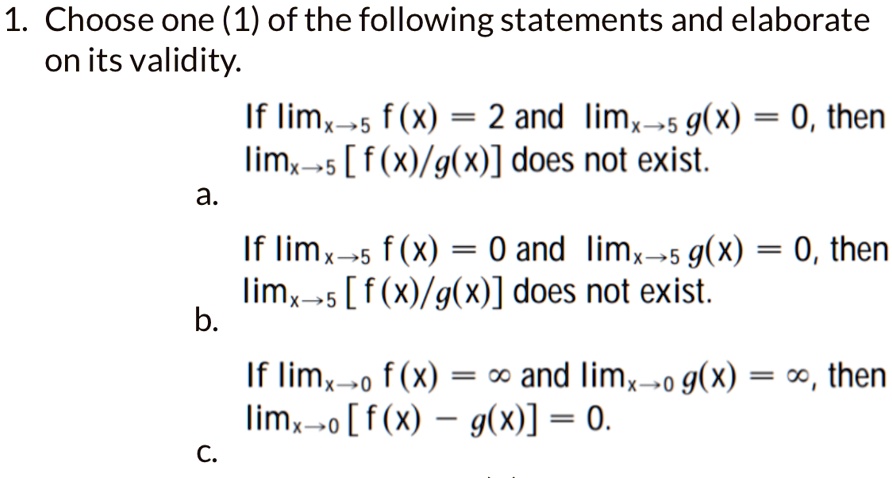
Choose one (1) of the following statements and elaborate on its validity.
If lim_(x->5)f(x)=2 and lim_(x->5)g(x)=0, then lim_(x->5)[f(x)/(g)(x)] does not exist.
a. If lim_(x->5)f(x)=0 and lim_(x->5)g(x)=0, then
b. lim_(x->5)[f(x)/(g)(x)] does not exist.
If lim_(x->0)f(x)=infty and lim_(x->0)g(x)=infty , then
c. lim_(x->0)[f(x)-g(x)]=0.
Choose one (1) of the following statements and elaborate on its validity.
If lim x->5 f(x) = 2 and lim x->5 g(x) = 0, then lim x->5 [f(x)/g(x)] does not exist.
a. If lim x->5 f(x) = 0 and lim x->5 g(x) = 0, then
b. lim x->5 [f(x)/g(x)] does not exist.
If lim x->0 f(x) = ∞ and lim x->0 g(x) = ∞, then
c. lim x->0 [f(x)-g(x)] = 0.