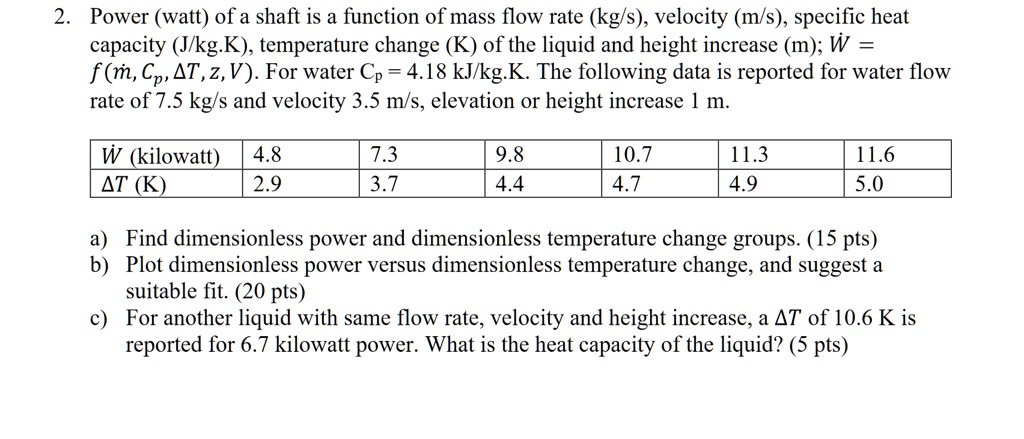
Power (watt) of a shaft is a function of mass flow rate (k(g)/(s)), velocity ((m)/(s)), specific heat
capacity ((J)/(k)g.K), temperature change (K) of the liquid and height increase (m);W^(˙)=
f((m^(˙)),C_(p),Delta T,z,V). For water C_(p)=4.18k(J)/(k)g.K. The following data is reported for water flow
rate of 7.5k(g)/(s) and velocity 3.5(m)/(s), elevation or height increase 1m.
a) Find dimensionless power and dimensionless temperature change groups. (15 pts)
b) Plot dimensionless power versus dimensionless temperature change, and suggest a
suitable fit. (20 pts)
c) For another liquid with same flow rate, velocity and height increase, a Delta T of 10.6K is
reported for 6.7 kilowatt power. What is the heat capacity of the liquid? (5 pts)
2. Power (watt) of a shaft is a function of mass flow rate (kg/s), velocity (m/s), specific heat capacity (J/kg.K), temperature change (K) of the liquid and height increase (m); W = f (m, Cp, T, z, V). For water Cp = 4.18 kJ/kg.K. The following data is reported for water flow rate of 7.5 kg/s and velocity 3.5 m/s, elevation or height increase 1 m.
W (kilowatt) T(K)
4.8 2.9
7.3 3.7
9.8 4.4
10.7 4.7
11.3 4.9
11.6 5.0
a) Find dimensionless power and dimensionless temperature change groups. (15 pts) b) Plot dimensionless power versus dimensionless temperature change, and suggest a suitable fit. (20 pts) c) For another liquid with same flow rate, velocity and height increase, a T of 10.6 K is reported for 6.7 kilowatt power. What is the heat capacity of the liquid? (5 pts)