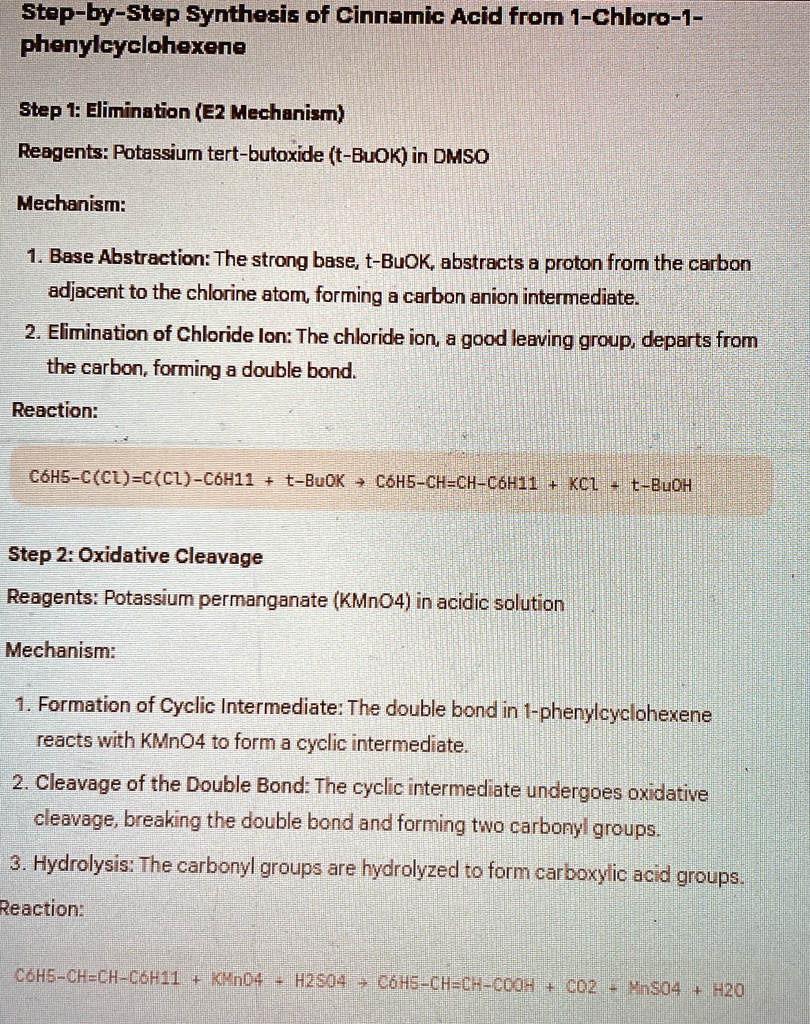
Step-by-Step Synthesis of Cinnamic Acid from 1-Chloro-1-phenylcyclohexene
Step 1: Elimination (E2 Mechanism)
Reagents: Potassium tert-butoxide (t-BuOK) in DMSO
Mechanism:
1. Base Abstraction: The strong base, t-BuOK, abstracts a proton from the carbon adjacent to the chlorine atom, forming a carbon anion intermediate.
2. Elimination of Chloride Ion: The chloride ion, a good leaving group, departs from the carbon, forming a double bond.
Reaction:
$C_6H_5-C(Cl)=C(Cl)-C_6H_{11} + t-BuOK \rightarrow C_6H_5-CH=CH-C_6H_{11} + KCl + t-BuOH$
Step 2: Oxidative Cleavage
Reagents: Potassium permanganate ($KMnO_4$) in acidic solution
Mechanism:
1. Formation of Cyclic Intermediate: The double bond in 1-phenylcyclohexene reacts with $KMnO_4$ to form a cyclic intermediate.
2. Cleavage of the Double Bond: The cyclic intermediate undergoes oxidative cleavage, breaking the double bond and forming two carbonyl groups.
3. Hydrolysis: The carbonyl groups are hydrolyzed to form carboxylic acid groups.
Reaction:
$C_6H_5-CH=CH-C_6H_{11} + KMnO_4 + H_2SO_4 \rightarrow C_6H_5-CH=CH-COOH + CO_2 + MnSO_4 + H_2O$