Pharmaceutical Manufactory Ltd. has a beta of 1.5 is expanding into a new, unrelated industry by way of forming a new division. The new division is furniture manufacturing, an industry where pure-play companies typically have a beta of 2.0. The risk-free rate is 8% and the market risk premium is 10%. What would an appropriate divisional beta be for the new division? Required: Copy or type the above question into a prompt and evaluate the feedback. Discuss your findings regarding the accuracy of the answer and how such a tool may best be employed, very briefly.
Question 1
(30 Marks)
Capital structure decision making, learning units 7, 13 and 14)
Read the following case and then answer the required section below the case:
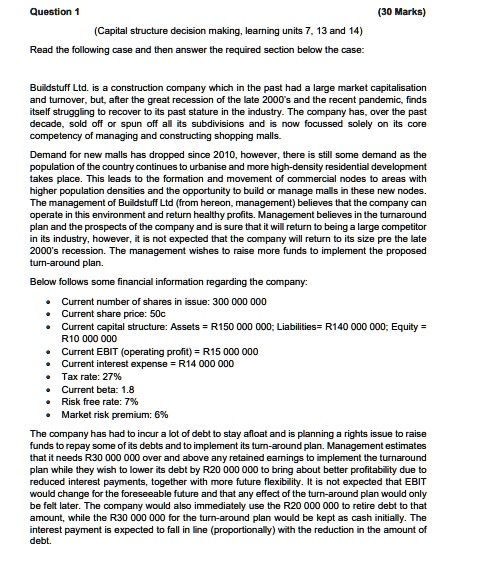
and turnover, but, after the great recession of the late 2000s and the recent pandemic, finds itself struggling to recover to its past stature in the industry. The company has, over the past decade, sold off or spun off all its subdivisions and is now focussed solely on its core competency of managing and constructing shopping malls. Demand for new malls has dropped since 2010, however, there is still some demand as the
takes place. This leads to the formation and movement of commercial nodes to areas with
operate in this environment and return healthy profits. Management believes in the turnaround
in its industry, however, it is not expected that the company will return to its size pre the late 2000s recession. The management wishes to raise more funds to implement the proposed turn-around plan.
Below follows some financial information regarding the company:
Current number of shares in issue: 300 000 000 Current share price: 50c Current capital structure: Assets = R150 000 000; Liabilities= R140 000 000; Equity = R10 000 000 Current EBIT (operating profit) = R15 000 000 Current interest expense = R14 000 000 Tax rate: 27% Current beta: 1.8 Risk free rate: 7% Market risk premium: 6%
The company has had to incur a lot of debt to stay afloat and is planning a rights issue to raise
that it needs R30 000 000 over and above any retained eamings to implement the turnaround plan while they wish to lower its debt by R20 000 000 to bring about better profitability due to reduced interest payments, together with more future flexibility. It is not expected that EBIT
be felt later. The company would also immediately use the R20 000 000 to retire debt to that
interest payment is expected to fall in line (proportionally) with the reduction in the amount of debt.