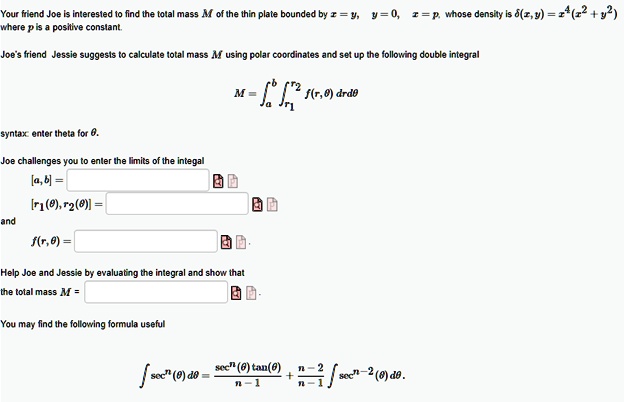
Your friend Joe is interested to find the total mass $M$ of the thin plate bounded by $x = y$, $y = 0$, $x = p$, whose density is $\delta(x, y) = x^4(x^2 + y^2)$ where $p$ is a positive constant.
Joe's friend Jessie suggests to calculate total mass $M$ using polar coordinates and set up the following double integral
$M = \int_a^b \int_{r_1}^{r_2} f(r, \theta) \, dr \, d\theta$
syntax: enter theta for $\theta$.
Joe challenges you to enter the limits of the integral
$[a, b] = $
$[r_1(\theta), r_2(\theta)] = $
and
f(r, \theta) = $
Help Joe and Jessie by evaluating the integral and show that
the total mass $M = $
You may find the following formula useful
$\int \sec^n(\theta) \, d\theta = \frac{\sec^{n-2}(\theta)\tan(\theta)}{n - 1} + \frac{n - 2}{n - 1} \int \sec^{n-2}(\theta) \, d\theta.$