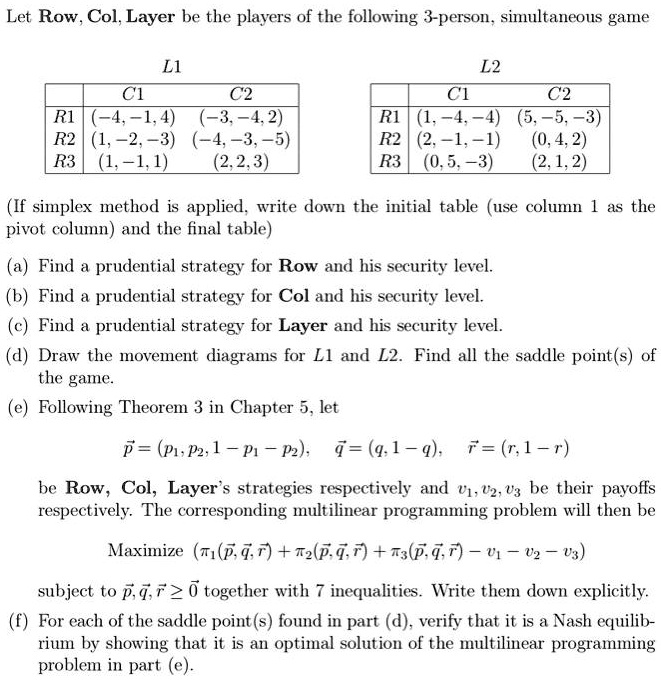
Let Row, Col, Layer be the players of the following 3-person, simultaneous game
L1
L2
C1
C2
C1
C2
R1 (-4,-1,4) (-3,-4,2)
R1 (1,-4,-4) (5,-5,-3)
R2 (1,-2,-3) (-4,-3,-5)
R2 (2,-1,-1) (0,4,2)
R3 (1,-1,1) (2,2,3)
R3 (0,5,-3) (2,1,2)
(If simplex method is applied, write down the initial table (use column 1 as the
pivot column) and the final table)
(a) Find a prudential strategy for Row and his security level.
(b) Find a prudential strategy for Col and his security level.
(c) Find a prudential strategy for Layer and his security level.
(d) Draw the movement diagrams for L1 and L2. Find all the saddle point(s) of
the game.
(e) Following Theorem 3 in Chapter 5, let
$\vec{p} = (p_1, p_2, 1 - p_1 - p_2)$, $\vec{q} = (q, 1 - q)$, $\vec{r} = (r, 1 - r)$
be Row, Col, Layer's strategies respectively and $v_1, v_2, v_3$ be their payoffs
respectively. The corresponding multilinear programming problem will then be
Maximize ($\pi_1(\vec{p}, \vec{q}, \vec{r}) + \pi_2(\vec{p}, \vec{q}, \vec{r}) + \pi_3(\vec{p}, \vec{q}, \vec{r}) - v_1 - v_2 - v_3$)
subject to $\vec{p}, \vec{q}, \vec{r} \ge 0$ together with 7 inequalities. Write them down explicitly.
(f) For each of the saddle point(s) found in part (d), verify that it is a Nash equilib-
rium by showing that it is an optimal solution of the multilinear programming
problem in part (e).