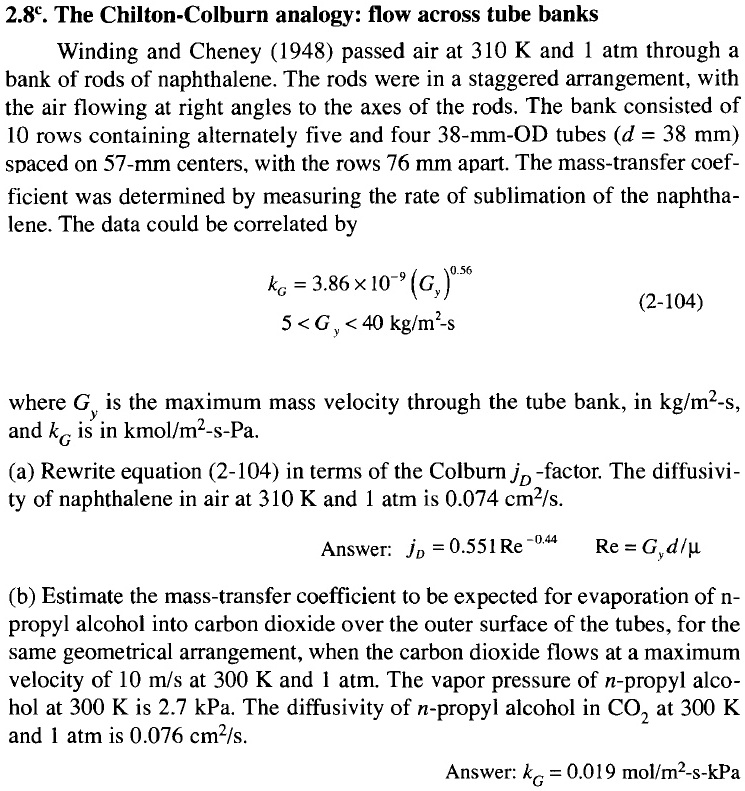
2.8c. The Chilton-Colburn analogy: flow across tube banks
Winding and Cheney (1948) passed air at 310 K and 1 atm through a bank of rods of naphthalene. The rods were in a staggered arrangement, with the air flowing at right angles to the axes of the rods. The bank consisted of 10 rows containing alternately five and four 38-mm-OD tubes (d = 38 mm) spaced on 57-mm centers, with the rows 76 mm apart. The mass-transfer coefficient was determined by measuring the rate of sublimation of the naphthalene. The data could be correlated by
kc = 3.86 x 10^(-G,) 5 < G < 40 kg/m^2-s
(2-104)
where G is the maximum mass velocity through the tube bank, in kg/m^2-s and kc is in kmol/m^2-s-Pa.
(a) Rewrite equation (2-104) in terms of the Colburn j-factor. The diffusivity of naphthalene in air at 310 K and 1 atm is 0.074 cm^2/s.
Answer: j = 0.551Re^(-0.44) Re = Gd/u
(b) Estimate the mass-transfer coefficient to be expected for evaporation of n-propyl alcohol into carbon dioxide over the outer surface of the tubes, for the same geometrical arrangement, when the carbon dioxide flows at a maximum velocity of 10 m/s at 300 K and 1 atm. The vapor pressure of n-propyl alcohol at 300 K is 2.7 kPa. The diffusivity of n-propyl alcohol in CO2 at 300 K and 1 atm is 0.076 cm^2/s.
Answer: kc = 0.019 mol/m^2-s-kPa