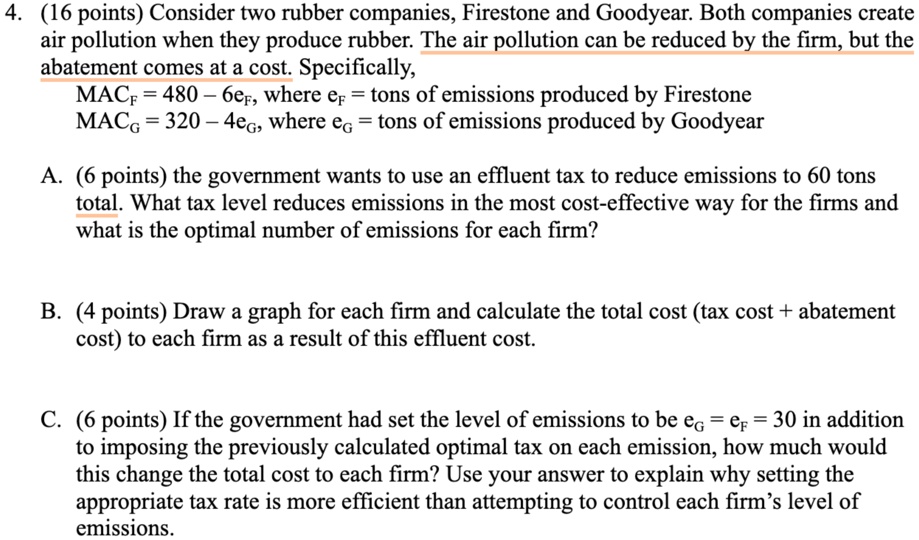
4. (16 points) Consider two rubber companies, Firestone and Goodyear. Both companies create
air pollution when they produce rubber. The air pollution can be reduced by the firm, but the
abatement comes at a cost. Specifically,
MACF = 480 - 6eF, where eF = tons of emissions produced by Firestone
MACG = 320 - 4eG, where eG = tons of emissions produced by Goodyear
A. (6 points) the government wants to use an effluent tax to reduce emissions to 60 tons
total. What tax level reduces emissions in the most cost-effective way for the firms and
what is the optimal number of emissions for each firm?
B. (4 points) Draw a graph for each firm and calculate the total cost (tax cost + abatement
cost) to each firm as a result of this effluent cost.
C. (6 points) If the government had set the level of emissions to be eG = eF = 30 in addition
to imposing the previously calculated optimal tax on each emission, how much would
this change the total cost to each firm? Use your answer to explain why setting the
appropriate tax rate is more efficient than attempting to control each firm's level of
emissions.