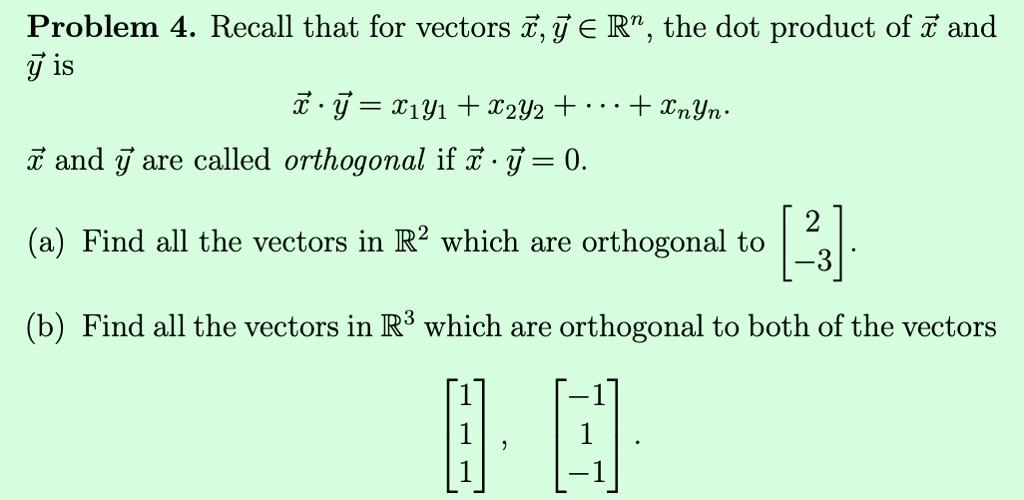
Problem 4. Recall that for vectors vec(x), vec(y) in R^(n), the dot product of vec(x) and
vec(y) is
vec(x) * vec(y) = x_(1)y_(1) + x_(2)y_(2) + cdots + x_(n)y_(n).
vec(x) and vec(y) are called orthogonal if vec(x) * vec(y) = 0.
(a) Find all the vectors in R^(2) which are orthogonal to [[2],[-3]].
(b) Find all the vectors in R^(3) which are orthogonal to both of the vectors
[[1],[1],[1]], [[-1],[1],[-1]]
Problem 4. Recall that for vectors x, u in R^n, the dot product of x and y is x.y = x1y1 + x2y2 + ... + xny_n
x and y are called orthogonal if x . y = 0.
(a) Find all the vectors in R^2 which are orthogonal to
(b) Find all the vectors in R^3 which are orthogonal to both of the vectors
1