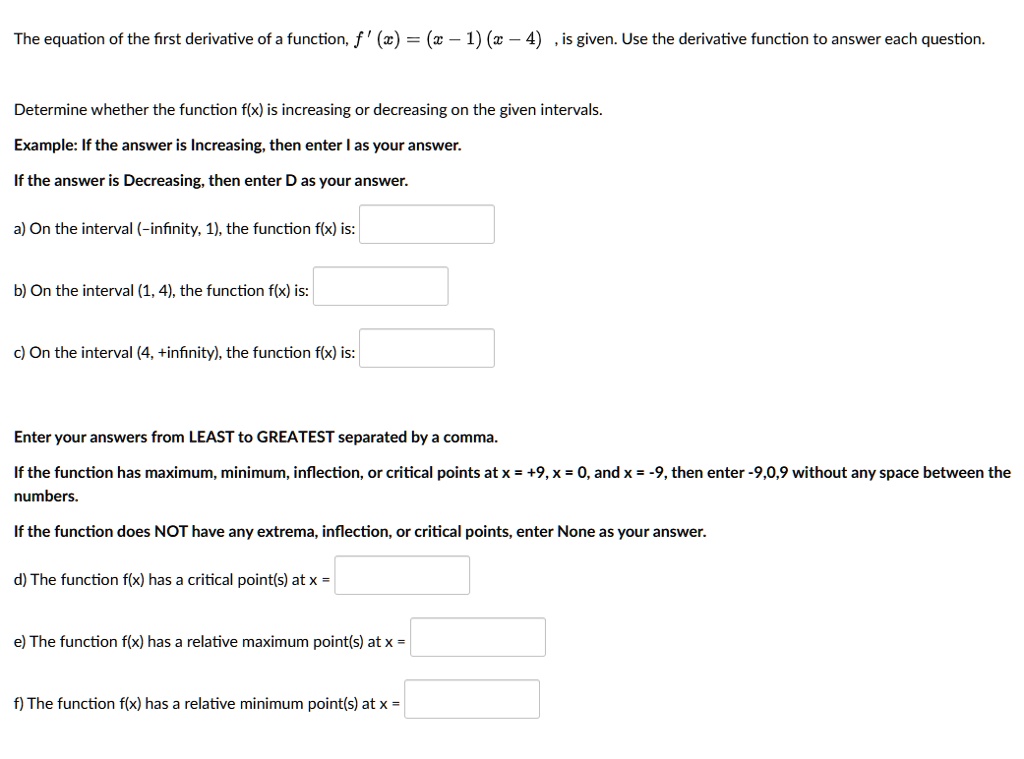
The equation of the first derivative of a function, f^(')(x)=(x-1)(x-4), is given. Use the derivative function to answer each question.
Determine whether the function f(x) is increasing or decreasing on the given intervals.
Example: If the answer is Increasing, then enter I as your answer.
If the answer is Decreasing, then enter D as your answer.
a) On the interval (-infinity, 1), the function f(x) is:
b) On the interval (1,4), the function f(x) is:
c) On the interval ( 4 , +infinity), the function f(x) is:
Enter your answers from LEAST to GREATEST separated by a comma.
If the function has maximum, minimum, inflection, or critical points at x=+9,x=0, and x=-9, then enter -9,0,9 without any space between the numbers.
If the function does NOT have any extrema, inflection, or critical points, enter None as your answer.
d) The function f(x) has a critical point(s) at x=
e) The function f(x) has a relative maximum point(s) at x=
f) The function f(x) has a relative minimum point(s) at x=
The equation of the frst derivative of a function, f ()=( -1)( -4),is given. Use the derivative function to answer each question
Determine whether the function f(x) is increasing or decreasing on the given intervals.
Example:If the answer is Increasing,then enter I as your answer.
If the answer is Decreasing, then enter D as your answer.
a)On the interval-infinity,1),the function fx) is
b) On the interval 1,4), the function fx) is:
c) On the interval (4,+infinity),the function f(x) is
Enter your answers from LEAST to GREATEST separated by a comma.
If the function has maximum, minimum, inflection, or critical points at x = +9, x = 0, and x = -9, then enter -9,0,9 without any space between the numbers.
If the function does NOT have any extrema, inflection, or critical points, enter None as your answer.
d) The function f(x) has a critical point(s) at x =
e) The function f(x) has a relative maximum point(s) at x
f)The function f(x)has a relative minimum point(s) at x =