Ace - AI Tutor
Ask Our Educators
Textbooks
My Library
Flashcards
Scribe - AI Notes
Notes & Exams
Download App
cynthia singh

cynthia s.

Divider

Questions asked

BEST MATCH

An ISE 261 test consists of 12 questions. Six are True-False questions, and Six are multiple-choice questions that have five choices each. A student must select an answer for each question. In how many ways can this be done?

View Answer
divider
BEST MATCH

The number 48 has 10 factors than come in 5 pairs. Carmina wants to know if every counting number always has an even number of factors. Investigate Carmina's question carefully. When does a counting number have an even number of factors, and when does it not?

View Answer
divider
BEST MATCH

Financial statements reflect only the book values of the data that analysts use to evaluate a company’s performance. To incorporate market values, two additional performance measures were developed—market value added (MVA) and economic value added (EVA). The EVA metric effectively measures the amount of shareholder wealth that the firm’s management has during a specific period of time. A EVA value indicates that the firm’s managers have reduced the firm’s value, and shareholders might have earned more value by investing in some other investment with the same risk level.

View Answer
divider
BEST MATCH

Calculate the slope of the line containing the points (8, -9) and (-2, 5).

View Answer
divider
BEST MATCH

Perform the indicated operation and write the result in standard form.\\ $\sqrt{-4} - \sqrt{-25}$ \\ $\sqrt{-4} - \sqrt{-25} = $\\ (Simplify your answer. Express complex numbers in terms of $i$. Type an exact answer, using radicals as needed.

View Answer
divider
BEST MATCH

Part 1 of 4 A patient receives an injection of a drug. After the injection, the amount of drug in the bloodstream is halved every 40 minutes. Suppose that immediately after the injection, the amount in the patient's bloodstream is 16 mg/liter. After 40 minutes, how much will be in the patient's bloodstream? mg/liter.

View Answer
divider
BEST MATCH

5 Complex Exponential Fourier Series Express the complex exponential Fourier series of v?(t) in Figure 1(a) using the complex exponential Fourier series of v?(t) in Figure 1(b). The complex exponential Fourier series of v?(t) in Figure 1(b) is given by $\infty$ $v_2(t) = \sum_{n=-\infty} D_n e^{jn\omega_0 t}$. Figure 1. (a) Periodic square pulse v?(t). Time in seconds. (b) Periodic square pulse v?(t). Time in milliseconds.

View Answer
divider
BEST MATCH

Apply Logarithmic Functions In this activity, you will investigate how logarithmic functions are used to model situations in many different fields. Problem 1: A Caffeine Problem The half-life of caffeine is approximately 5 hours; this means that approximately ½ of the caffeine in the bloodstream is eliminated every 5 hours. Suppose you drink a can of Instant Energy, a 16-ounce energy drink that contains 160 mg of caffeine. Suppose the caffeine in your bloodstream peaks at 160 mg. 1au1 1. How much caffeine will remain in your bloodstream after 5 hours? 10 hours? 1 hour? 2 hours? Record your answers in the table. Explain how you came up with your answers. (You can return to your answers later to make any corrections if you find your strategy was incorrect.) ba4 Time (hours) since 0 peak level reached a Caffeine bloodstream (mg) in 160 1 2 5 10 5720) In..EXPRESS uted proper. 2. Write an exponential function f to model the amount of caffeine remaining in the blood stream t hours after the peak level. What does your exponent need to represent? How can you determine this exponent if you know the number of hours that has passed? eliblede 3. Use the function you wrote in question (2) to check your answers for the table in question (1). Make any necessary corrections. (Be careful when entering fractional exponents in the calculator. Use parentheses.) trigong orth one 4. Determine the amount of caffeine remaining in the bloodstream 3 hours after the peak level. What about 8 hours after peak level? 20 hours? Apply-Logarithmic Functions In this activity, you will investigate how logarithmic functions are used to model situations in many different fields. Problem 1:A Caffeine Problem The half-life of caffeine is approximately 5 hours; this means that approximately / of the caffeine in the bloodstream is eliminated every 5 hours.Suppose you the caffeine in your bloodstream peaks at 160 mg. 1How much caffeine will remain in your bloodstream after 5 hours? 10 hours1 hour 2 hours? Record your answers in the table.Explain how you came up with your answers.You can return to your answers later to make any corrections if you find your strategy was incorrect. Time hourssince 2 10 peak level reached Caffeine in 160 bloodstream(mg 2. Write an exponential function f to model the amount of caffeine remaining in the blood stream t hours afler the peak level. What does your exponent need to represent? How can you determine this exponent if you know the number of hours that has passed? 3.Use the function you wrote in question 2 to check your answers for the table in question (1. Make any necessary corrections.Be careful when entering fractional exponents in the calculator.Use parentheses.) 4. Determine the amount of caffeine remaining in the bloodstream 3 hours after the peak level.What about 8 hours after peak level?20 hours?

View Answer
divider
BEST MATCH

Use a numerical solver and Euler's method to obtain a four-decimal approximation of the indicated value. First use $h = 0.1$ and then use $h = 0.05$. $y' = (x - y)^2$, $y(0) = 0.5$; y(0.5) $y(0.5) \approx$ \(h = 0.1) y(0.5) \approx \(h = 0.05)

View Answer
divider
BEST MATCH

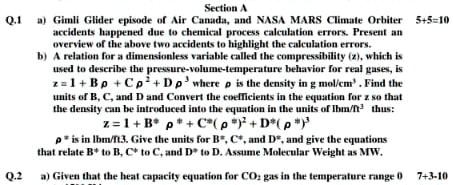
Section A Q.1 a) Gimli Glider episode of Air Canada, and NASA MARS Climate Orbiter 5+5=10 accidents happened due to chemical process calculation errors. Present an overview of the above two accidents to highlight the calculation errors. b) A relation for a dimensionless variable called the compressibility (z), which is used to describe the pressure-volume-temperature behavior for real gases, is z = 1 + B$\rho$ + C$\rho$^2 + D$\rho$^3 where $\rho$ is the density in g mol/cm$^3$. Find the units of B, C, and D and Convert the coefficients in the equation for z so that the density can be introduced into the equation in the units of lbm/ft$^3$ thus: z = 1 + B* $\rho$* + C*($\rho$*)^2 + D*($\rho$*)^3 $\rho$* is in lbm/ft$^3$. Give the units for B*, C*, and D*, and give the equations that relate B* to B, C* to C, and D* to D. Assume Molecular Weight as MW. Q.2 a) Given that the heat capacity equation for CO$_2$ gas in the temperature range 0 7+3-10
View Answer
divider