You may need to use the appropriate technology to answer this question.
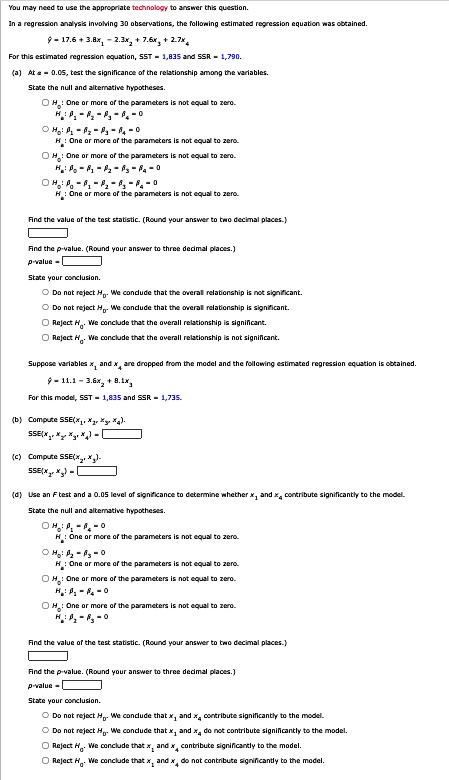
In a regression analysis involving 30 observations, the following estimated regression equation was obtained.
$\hat{y} = 17.6 + 3.8x_1 - 2.3x_2 + 7.6x_3 + 2.7x_4$
For this estimated regression equation, SST = 1,835 and SSR = 1,790.
(a) At $\alpha = 0.05$, test the significance of the relationship among the variables.
State the null and alternative hypotheses.
$H_0: \beta_1 = \beta_2 = \beta_3 = \beta_4 = 0$
$H_1$: One or more of the parameters is not equal to zero.
Find the value of the test statistic. (Round your answer to two decimal places.)
Find the $p$-value. (Round your answer to three decimal places.)
$p$-value =
State your conclusion.
Do not reject $H_0$. We conclude that the overall relationship is not significant.
Do not reject $H_0$. We conclude that the overall relationship is significant.
Reject $H_0$. We conclude that the overall relationship is significant.
Reject $H_0$. We conclude that the overall relationship is not significant.
Suppose variables $x_1$ and $x_4$ are dropped from the model and the following estimated regression equation is obtained.
$\hat{y} = 11.1 - 3.6x_2 + 8.1x_3$
For this model, SST = 1,835 and SSR = 1,735.
(b) Compute SSE($x_1, x_2, x_3, x_4$).
SSE($x_1, x_2, x_3, x_4$) =
(c) Compute SSE($x_2, x_3$).
SSE($x_2, x_3$) =
(d) Use an F test and a 0.05 level of significance to determine whether $x_1$ and $x_4$ contribute significantly to the model.
State the null and alternative hypotheses.
$H_0: \beta_1 = \beta_4 = 0$
$H_1$: One or more of the parameters is not equal to zero.
Find the value of the test statistic. (Round your answer to two decimal places.)
Find the $p$-value. (Round your answer to three decimal places.)
$p$-value =
State your conclusion.
Do not reject $H_0$. We conclude that $x_1$ and $x_4$ contribute significantly to the model.
Do not reject $H_0$. We conclude that $x_1$ and $x_4$ do not contribute significantly to the model.
Reject $H_0$. We conclude that $x_1$ and $x_4$ contribute significantly to the model.
Reject $H_0$. We conclude that $x_1$ and $x_4$ do not contribute significantly to the model.