Question 3 (20 points)
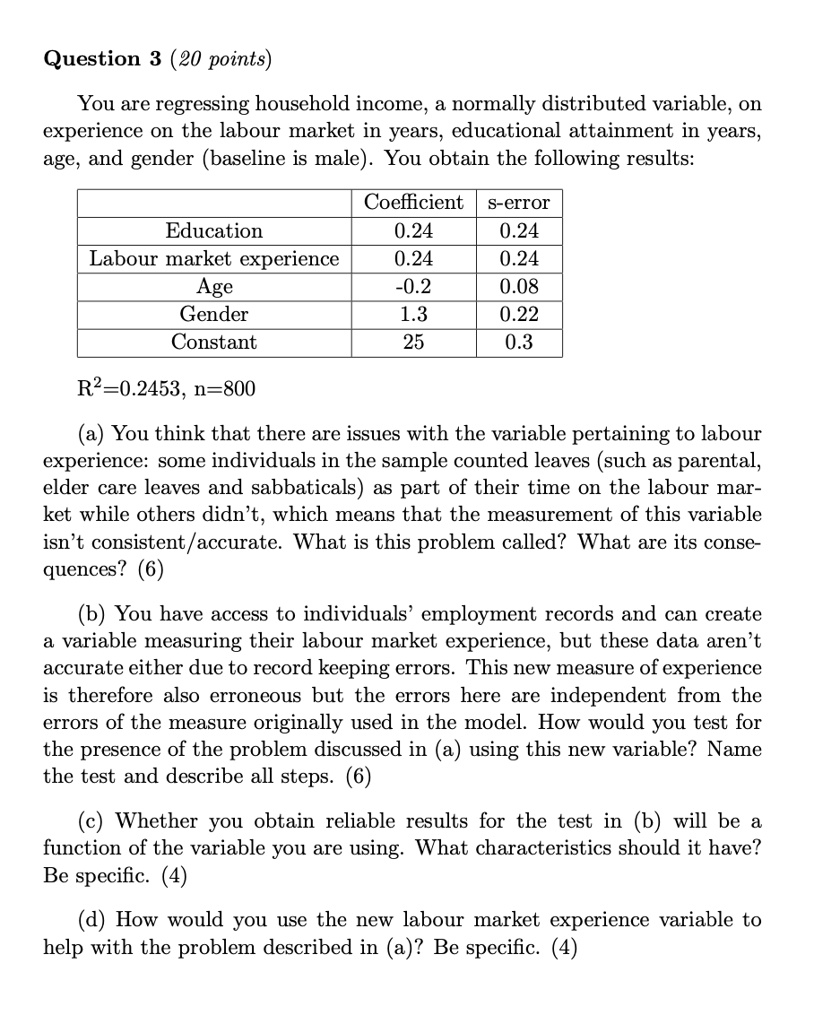
You are regressing household income, a normally distributed variable, on
experience on the labour market in years, educational attainment in years,
age, and gender (baseline is male). You obtain the following results:
Education
Labour market experience
Age
Gender
Constant
Coefficient
s-error
0.24
0.24
0.24
0.24
-0.2
0.08
1.3
0.22
25
0.3
$R^2$=0.2453, n=800
(a) You think that there are issues with the variable pertaining to labour
experience: some individuals in the sample counted leaves (such as parental,
elder care leaves and sabbaticals) as part of their time on the labour mar-
ket while others didn't, which means that the measurement of this variable
isn't consistent/accurate. What is this problem called? What are its conse-
quences? (6)
(b) You have access to individuals' employment records and can create
a variable measuring their labour market experience, but these data aren't
accurate either due to record keeping errors. This new measure of experience
is therefore also erroneous but the errors here are independent from the
errors of the measure originally used in the model. How would you test for
the presence of the problem discussed in (a) using this new variable? Name
the test and describe all steps. (6)
(c) Whether you obtain reliable results for the test in (b) will be a
function of the variable you are using. What characteristics should it have?
Be specific. (4)
(d) How would you use the new labour market experience variable to
help with the problem described in (a)? Be specific. (4)