Ace - AI Tutor
Ask Our Educators
Textbooks
My Library
Flashcards
Scribe - AI Notes
Notes & Exams
Download App
dana daniel

dana d.

Divider

Questions asked

BEST MATCH

Which coliform is the most common cause of urinary tract infections occurring outside of healthcare settings? Group of answer choices Klebsiella pneumoniae Enterobacter Escherichia coli Serratia marcescens Proteus mirabilis

View Answer
divider
BEST MATCH

which of the following describes the action of an inhaler such as albuterol? 1. dilates the bronchi. 2. dilates the bronchioles. 3. reduces swelling in the airway. 4 decreases secretions in the airway.

View Answer
divider
BEST MATCH

The NCVS is the only national data source for which of the following crime categories... Sexual Assaults White Collar Crimes Crimes against persons with disabilities Crimes against property

View Answer
divider
BEST MATCH

A die is rolled. What is the probability of rolling a number that is greater than 6? 1/6 Option 1 5/6 Option 3 6/6 Option 4 0/6 Option 2

View Answer
divider
BEST MATCH

Find the eigenvalues and eigenvectors of the given matrix.\\ $\begin{bmatrix} -4 & 1 & 0\\ 0 & -4 & 1\\ -1 & 1 & -3 \end{bmatrix}$\\The eigenvalue(s) is/are

View Answer
divider
BEST MATCH

Question 8 A room is 10 ft \times 15 ft \times 15 ft. If the temperature change from 22 $^\circ$C to -10 $^\circ$C, the volume (in liters) of the air which moved in or out of the room is liters.

View Answer
divider
BEST MATCH

The net power flow in the $+z$ direction for contradirectional coupling is $|A_1|^2 - |A_2|^2$. Show that $d\left(|A_1|^2 - |A_2|^2\right)/dz = 0$, where $A_1$ and $A_2$ satisfy the following coupled equations: $\frac{d}{dz}A_1 = -i\kappa A_2(z)e^{i\Delta\beta z}$ $\frac{d}{dz}A_2 = i\kappa^* A_1(z)e^{-i\Delta\beta z}$

View Answer
divider
BEST MATCH

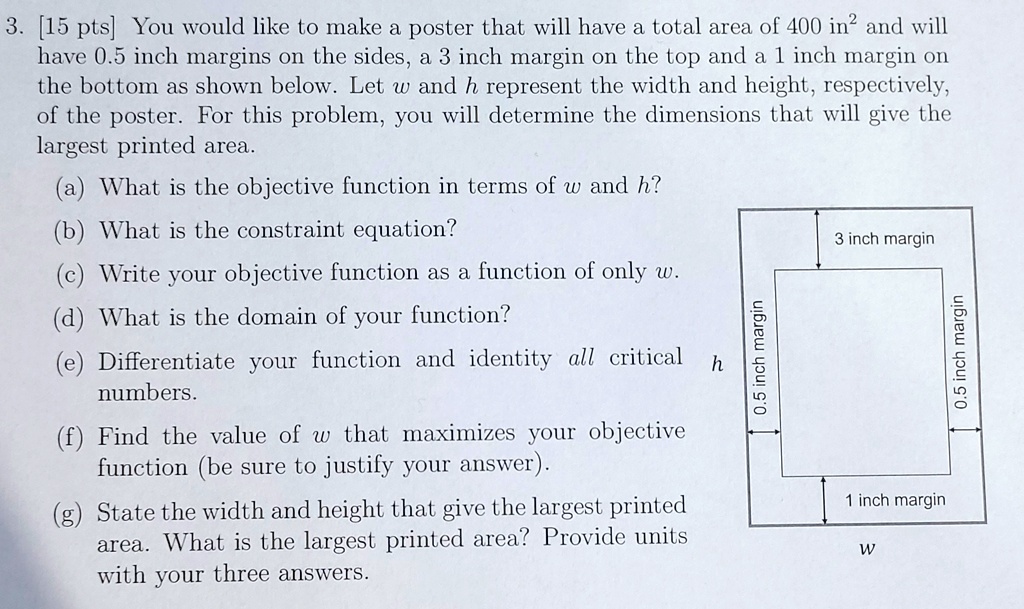
3. [15 pts] You would like to make a poster that will have a total area of 400 in² and will have 0.5 inch margins on the sides, a 3 inch margin on the top and a 1 inch margin on the bottom as shown below. Let $w$ and $h$ represent the width and height, respectively, of the poster. For this problem, you will determine the dimensions that will give the largest printed area. (a) What is the objective function in terms of $w$ and $h$? (b) What is the constraint equation? (c) Write your objective function as a function of only $w$. (d) What is the domain of your function? (e) Differentiate your function and identity all critical numbers. (f) Find the value of $w$ that maximizes your objective function (be sure to justify your answer). (g) State the width and height that give the largest printed area. What is the largest printed area? Provide units with your three answers.
View Answer
divider
BEST MATCH

Question 2: Forced Vibrations: Consider the same structure loaded by a harmonic force: rad P(t) = P<sub>0</sub>sin(?t), where P<sub>0</sub> = 5kN and ? = 35 (see Figure 3). s i. Formulate the equation of motion describing forced vibration of the damped system. ii. Determine the frequency ratio ? = ?/?<sub>n</sub>. For the same initial conditions as in Question 1iv, write the solution of the equation from Question 2i. iii. Show and explain which part of the solution will be quickly 'damped out'. Explain why steady-state response is of interest. iv. Comment on the effect of frequency ratio ? by introducing the dynamic response factor R<sub>D</sub> = u<sub>0</sub>/(u<sub>st</sub>)<sub>0</sub>. What would happen if ? = 1, and the system was undamped?

View Answer
divider
BEST MATCH

1. Consider a steel alloy with uniform (base) composition 0.25wt% carbon. The material is to be heat treated at 950°C. If the carbon concentration at the surface is suddenly brought to and maintained at 1.2 wt.% C, how long will it take to achieve a carbon content of 0.4wt.% at a position 1.0 mm below the surface. The diffusion coefficient for carbon in iron at this temperature is $1.6 \times 10^{-11}$ m²/s; assume that semi-infinite solid analysis is applicable. [8 pts] Note that: For steady state diffusion: $J = -D \frac{dC}{dx}$ For non-steady state diffusion: $\frac{C_x - C_0}{C_s - C_0} = 1 - erf(\frac{x}{2\sqrt{Dt}})$

View Answer
divider