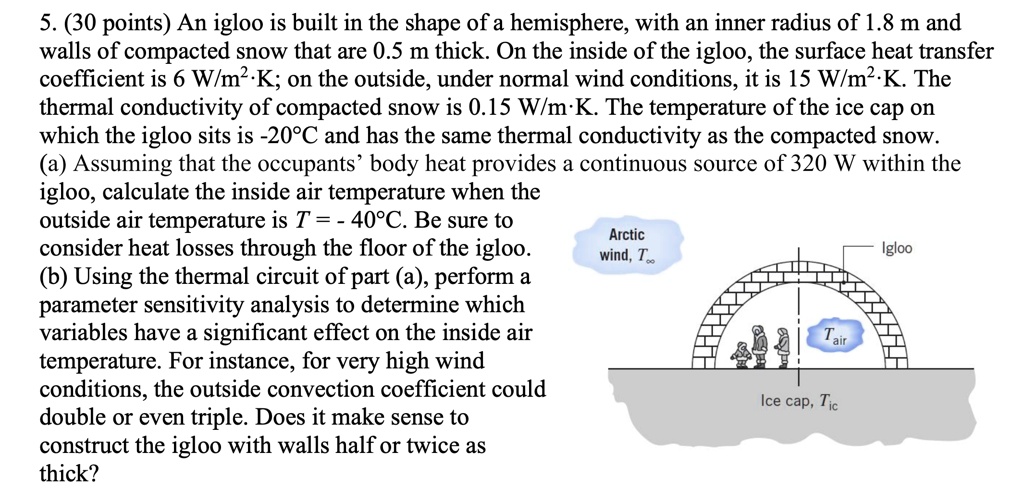
5. (30 points) An igloo is built in the shape of a hemisphere, with an inner radius of 1.8 m and
walls of compacted snow that are 0.5 m thick. On the inside of the igloo, the surface heat transfer
coefficient is 6 W/m²K; on the outside, under normal wind conditions, it is 15 W/m²K. The
thermal conductivity of compacted snow is 0.15 W/m·K. The temperature of the ice cap on
which the igloo sits is -20°C and has the same thermal conductivity as the compacted snow.
(a) Assuming that the occupants' body heat provides a continuous source of 320 W within the
igloo, calculate the inside air temperature when the
outside air temperature is T = - 40°C. Be sure to
consider heat losses through the floor of the igloo.
(b) Using the thermal circuit of part (a), perform a
parameter sensitivity analysis to determine which
variables have a significant effect on the inside air
temperature. For instance, for very high wind
conditions, the outside convection coefficient could
double or even triple. Does it make sense to
construct the igloo with walls half or twice as
thick?
Arctic
wind, Too
Tair
Ice cap, Tic
Igloo