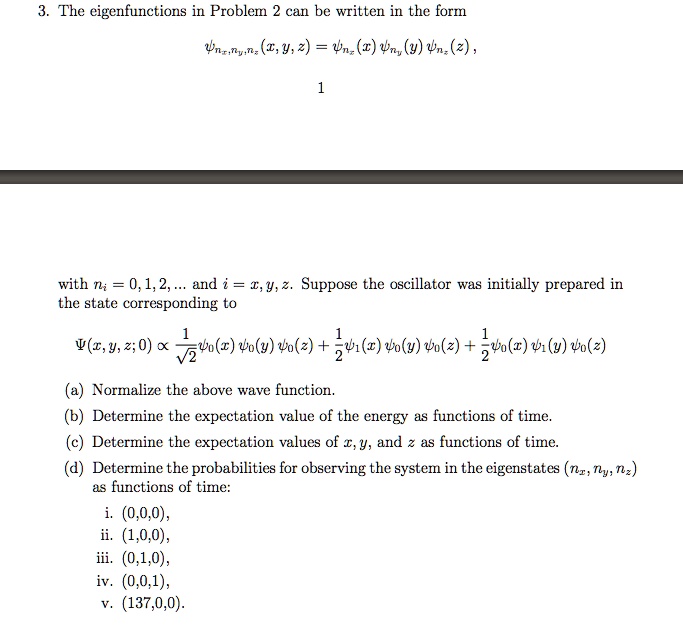
3. The eigenfunctions in Problem 2 can be written in the form
?n<sub>x</sub>,n<sub>y</sub>,n<sub>z</sub> (x, y, z) = ?n<sub>x</sub>(x) ?n<sub>y</sub>(y) ?n<sub>z</sub>(z),
1
with n<sub>i</sub> = 0, 1, 2, ... and i = x, y, z. Suppose the oscillator was initially prepared in
the state corresponding to
?(x, y, z; 0) ? \frac{1}{\sqrt{2}}?_0(x)?_0(y)?_0(z) + \frac{1}{2}?_1(x)?_0(y)?_0(z) + \frac{1}{2}?_0(x)?_1(y)?_0(z)
(a) Normalize the above wave function.
(b) Determine the expectation value of the energy as functions of time.
(c) Determine the expectation values of x, y, and z as functions of time.
(d) Determine the probabilities for observing the system in the eigenstates (n<sub>x</sub>, n<sub>y</sub>, n<sub>z</sub>)
as functions of time:
i. (0,0,0),
ii. (1,0,0),
iii. (0,1,0),
iv. (0,0,1),
v. (137,0,0).