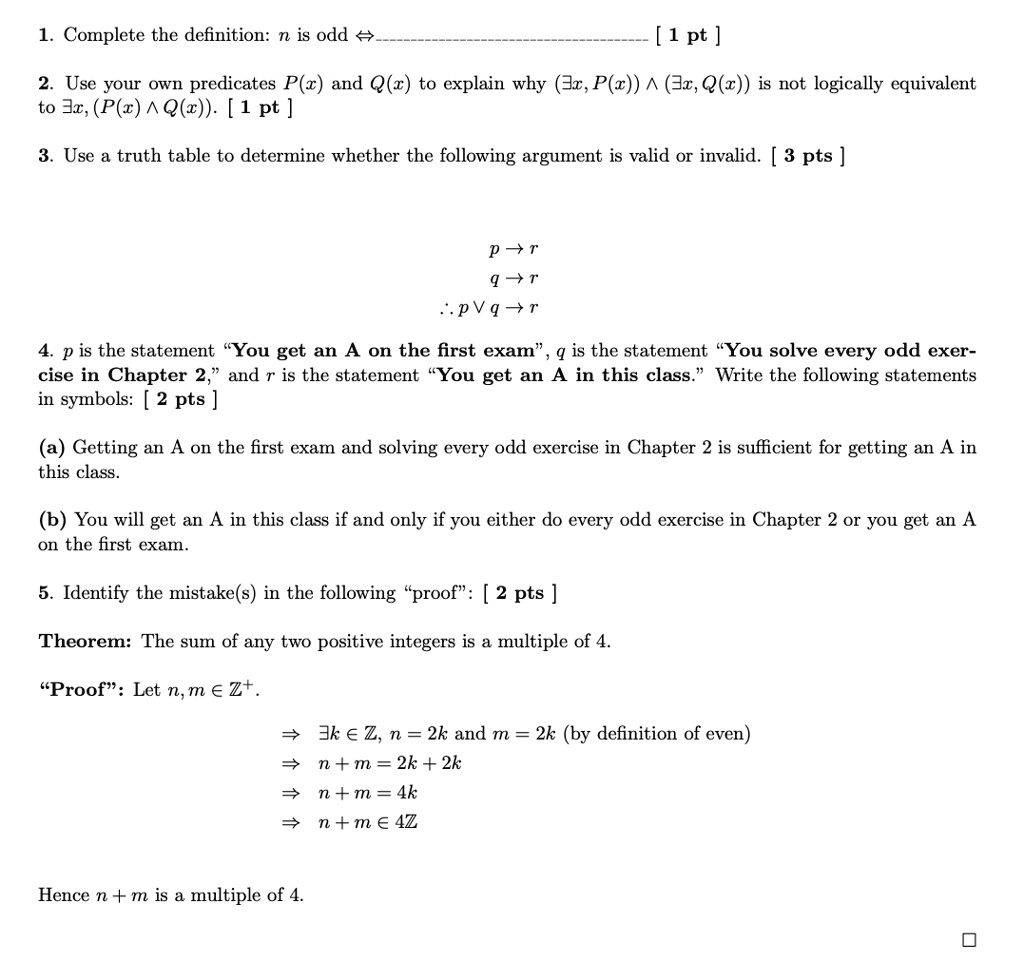
Complete the definition: n is odd <=>.
[ 1pt ]
Use your own predicates P(x) and Q(x) to explain why (EEx,P(x))^(^())(EEx,Q(x)) is not logically equivalent
to EEx,(P(x)^(^())Q(x)). [ 1pt
Use a truth table to determine whether the following argument is valid or invalid. [ 3 pts ]
p->r
q->r
:.pvvq->r
p is the statement "You get an A on the first exam", q is the statement "You solve every odd exer-
cise in Chapter 2," and r is the statement "You get an A in this class." Write the following statements
in symbols: [ 2 pts ]
(a) Getting an A on the first exam and solving every odd exercise in Chapter 2 is sufficient for getting an A in
this class.
(b) You will get an A in this class if and only if you either do every odd exercise in Chapter 2 or you get an A
on the first exam.
Identify the mistake(s) in the following "proof": [ 2 pts ]
Theorem: The sum of any two positive integers is a multiple of 4 .
"Proof": Let n,minZ^(+).
=>,EEkinZ,n=2k and m=2k (by definition of even)
=>n+m=2k+2k
=>n+m=4k
=>n+min4Z
Hence n+m is a multiple of 4 .
l.Complete the definition: n is odd
[1 pt]
2. Use your own predicates P() and Q() to explain why (x,P()) A (x,Q(x)) is not logically equivalent to 3x,(P(x) AQ(x)).[1 pt]
3. Use a truth table to determine whether the following argument is valid or invalid. [ 3 pts ]
ab
pVq->r
4. p is the statement "You get an A on the first exam", q is the statement "You solve every odd exer- cise in Chapter 2, and r is the statement "You get an A in this class." Write the following statements in symbols: [2 pts ]
(a) Getting an A on the first exam and solving every odd exercise in Chapter 2 is sufficient for getting an A in this class.
(b) You will get an A in this class if and only if you either do every odd exercise in Chapter 2 or you get an A on the first exam.
5. Identify the mistake(s) in the following "proof": [ 2 pts ]
Theorem: The sum of any two positive integers is a multiple of 4
"Proof": Let n,m E Z+.
k E Z, n=2k and m=2k (by definition of even)
=>n+m=2k+2k = n+m=4k = n+mE4Z
Hence n + m is a multiple of 4.