I need help with only part E, nothing else.
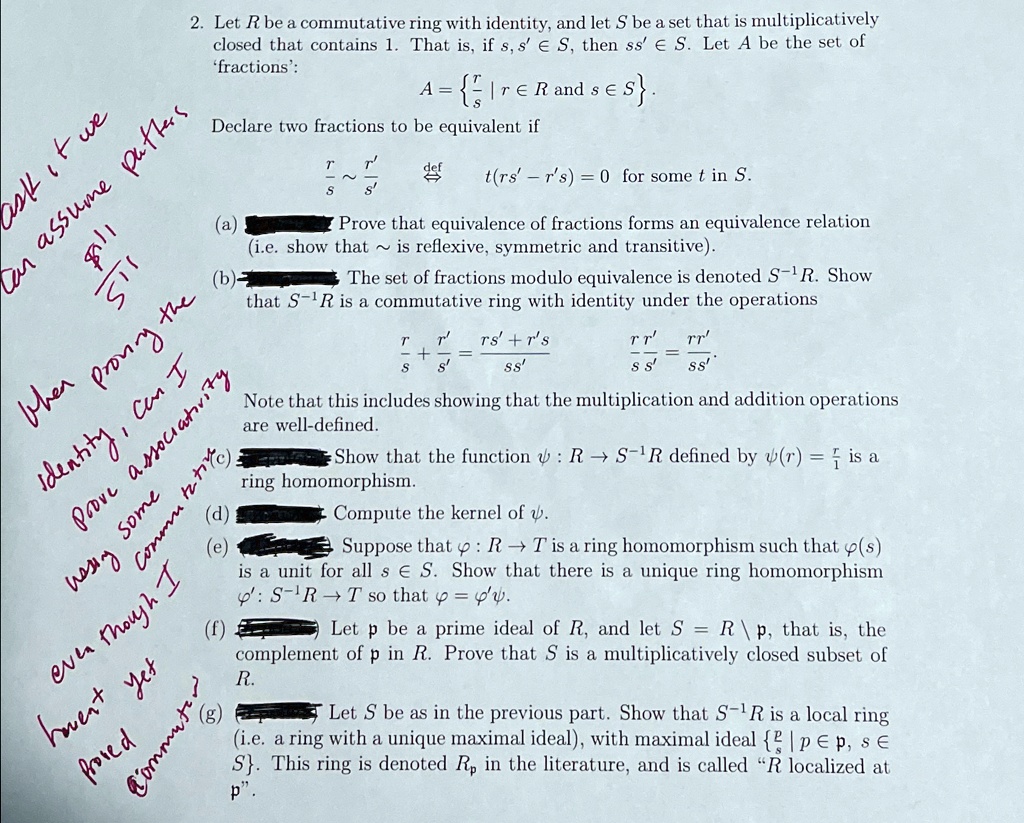
Let R be a commutative ring with identity, and let S be a set that is multiplicatively closed that contains 1. That is, if s, s' in S, then ss' in S. Let A be the set of 'fractions':
A = {(r)/(s) | r in R and s in S}.
Declare two fractions to be equivalent if
(r)/(s) ∼ (r')/(s'), <=> (def), t(rs' - r's) = 0 for some t in S.
(a) Prove that equivalence of fractions forms an equivalence relation (i.e. show that ∼ is reflexive, symmetric, and transitive).
(b) The set of fractions modulo equivalence is denoted S^(-1)R. Show that S^(-1)R is a commutative ring with identity under the operations
(r)/(s) + (r')/(s') = (rs' + r's)/(ss'), (r)/(s)(r')/(ss') = (rr')/(ss').
Note that this includes showing that the multiplication and addition operations are well-defined.
(c) Show that the function ψ: R -> S^(-1)R defined by ψ(r) = (r)/(1) is a ring homomorphism.
(d) Compute the kernel of ψ.
(e) Suppose that φ: R -> T is a ring homomorphism such that φ(s) is a unit for all s in S. Show that there is a unique ring homomorphism φ': S^(-1)R -> T so that φ = φ'ψ.
(f) Let p be a prime ideal of R, and let S = (R) / (p), that is, the complement of p in R. Prove that S is a multiplicatively closed subset of R.
(g) Let S be as in the previous part. Show that S^(-1)R is a local ring (i.e. a ring with a unique maximal ideal), with maximal ideal {((p)/(s) | p in p, s in S)}. This ring is denoted R_(p) in the literature, and is called "R localized at p".