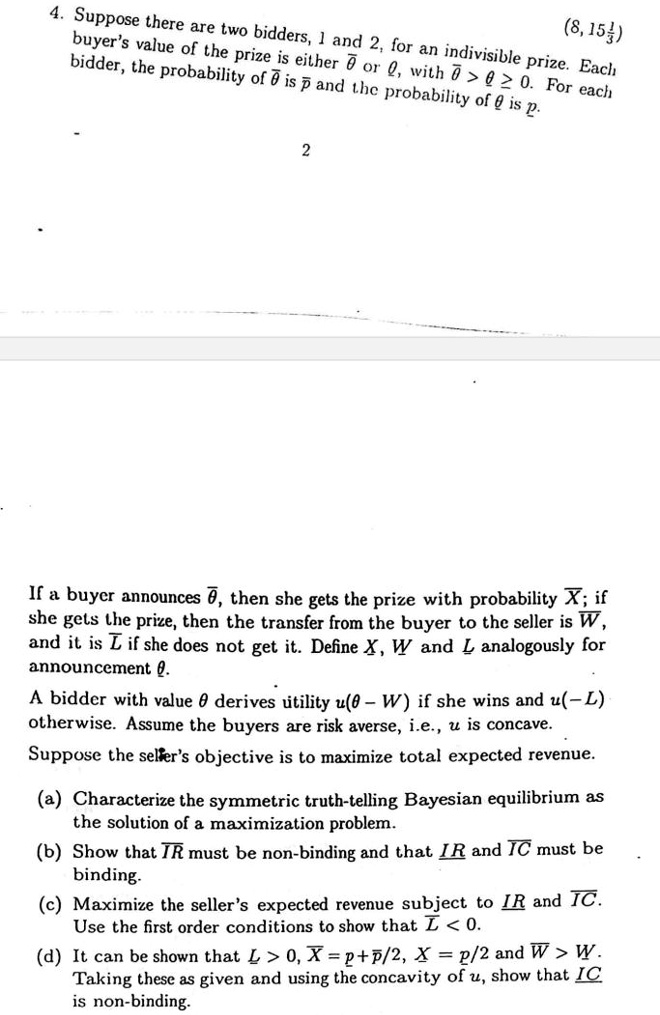
4. Suppose there are two bidders, 1 and 2, for an indivisible prize. Each buyer's value of the prize is either $\bar{\theta}$ or 0, with $\bar{\theta}$ ? 0. For each bidder, the probability of $\bar{\theta}$ is p and the probability of 0 is p.
2
If a buyer announces $\bar{\theta}$, then she gets the prize with probability X; if she gets the prize, then the transfer from the buyer to the seller is W, and it is L if she does not get it. Define X, W and L analogously for announcement 0.
A bidder with value $\theta$ derives utility u($\theta$ - W) if she wins and u(-L) otherwise. Assume the buyers are risk averse, i.e., u is concave.
Suppose the seller's objective is to maximize total expected revenue.
(a) Characterize the symmetric truth-telling Bayesian equilibrium as the solution of a maximization problem.
(b) Show that IR must be non-binding and that $\underline{IR}$ and IC must be binding.
(c) Maximize the seller's expected revenue subject to $\underline{IR}$ and IC. Use the first order conditions to show that L < 0.
(d) It can be shown that L > 0, X = p + p/2, X = p/2 and W > W. Taking these as given and using the concavity of u, show that IC is non-binding.