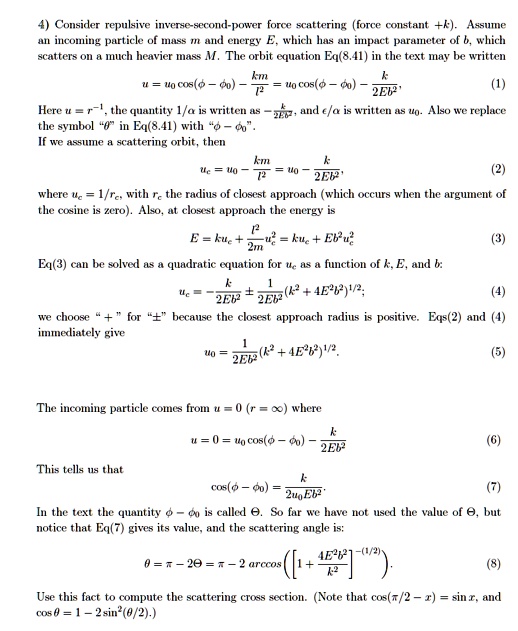
Consider repulsive inverse-second-power force scattering (force constant +k ). Assume
an incoming particle of mass m and energy E, which has an impact parameter of b, which
scatters on a much heavier mass M. The orbit equation Eq(8.41) in the text may be written
u=u_(0)cos(phi -phi _(0))-(km)/(l^(2))=u_(0)cos(phi -phi _(0))-(k)/(2Eb^(2)),
Here u=r^(-1), the quantity (1)/(alpha ) is written as -(k)/(2Esigma ^(2)), and epsi lo(n)/(alpha ) is written as u_(0). Also we replace
the symbol " heta " in Eq(8.41) with " phi -phi _(0) ".
If we assume a scattering orbit, then
u_(c)=u_(0)-(km)/(l^(2))=u_(0)-(k)/(2Eb^(2)),
where u_(c)=(1)/(r_(c)), with r_(c) the radius of closest approach (which occurs when the argument of
the cosine is zero). Also, at closest approach the energy is
E=ku_(c)+(l^(2))/(2m)u_(c)^(2)=ku_(c)+Eb^(2)u_(c)^(2)
Eq(3) can be solved as a quadratic equation for u_(c) as a function of k,E, and b :
u_(c)=-(k)/(2Eb^(2))+-(1)/(2Eb^(2))(k^(2)+4E^(2)b^(2))^((1)/(2));
we choose " + " for " +- " because the closest approach radius is positive. Eqs(2) and (4)
immediately give
u_(0)=(1)/(2Eb^(2))(k^(2)+4E^(2)b^(2))^((1)/(2)).
The incoming particle comes from u=0(r=infty ) where
u=0=u_(0)cos(phi -phi _(0))-(k)/(2Eb^(2))
This tells us that
cos(phi -phi _(0))=(k)/(2u_(0)Eb^(2)).
In the text the quantity phi -phi _(0) is called Theta . So far we have not used the value of Theta , but
notice that Eq(7) gives its value, and the scattering angle is:
heta =pi -2Theta =pi -2arccos([1+(4E^(2)b^(2))/(k^(2))]^(-((1)/(2)))).
Use this fact to compute the scattering cross section. (Note that cos((pi )/(2)-x)=sinx, and
cos heta =1-2sin^(2)(( heta )/(2)).)
4) Consider repulsive inverse-second-power force scattering (force constant +). Assume an incoming particle of mass m and energy E, which has an impact parameter of b, which scatters on a much heavier mass M. The orbit equation Eq(8.41) in the text may be written km k (1)
Here u = 1, the quantity 1/ is written as g, and e/ is written as uo. Also we replace the symbol g in Eq(8.41) with = If we assume a scattering orbit, then km k =u (2) 12 2E6 where , = 1/re, with re the radius of closest approach (which occurs when the argument of the cosine is zero). Also, at closest approach the energy is 12 E=ku+ u=kuc+Ebu (3)
Eq(3) can be solved as a quadratic equation for ue as a function of k, E, and b k 1 te=- k+4E21/2 (4) 2Eb22Eb2 we choose + for because the closest approach radius is positive. Eqs(2 and (4 immediately give 1 (5)
The incoming particle comes from u = 0 (r = ) where
u =0 =u cos( ) 2E
(6)
This tells us that
k
(7)
In the text the quantity = o is called . So far we have not used the value of O, but notice that Eq(7) gives its value, and the scattering angle is:
(8)
Use this fact to compute the scattering cross section. (Note that cos(/2 ) = sin , and cos=1 -2sin2(/2).)