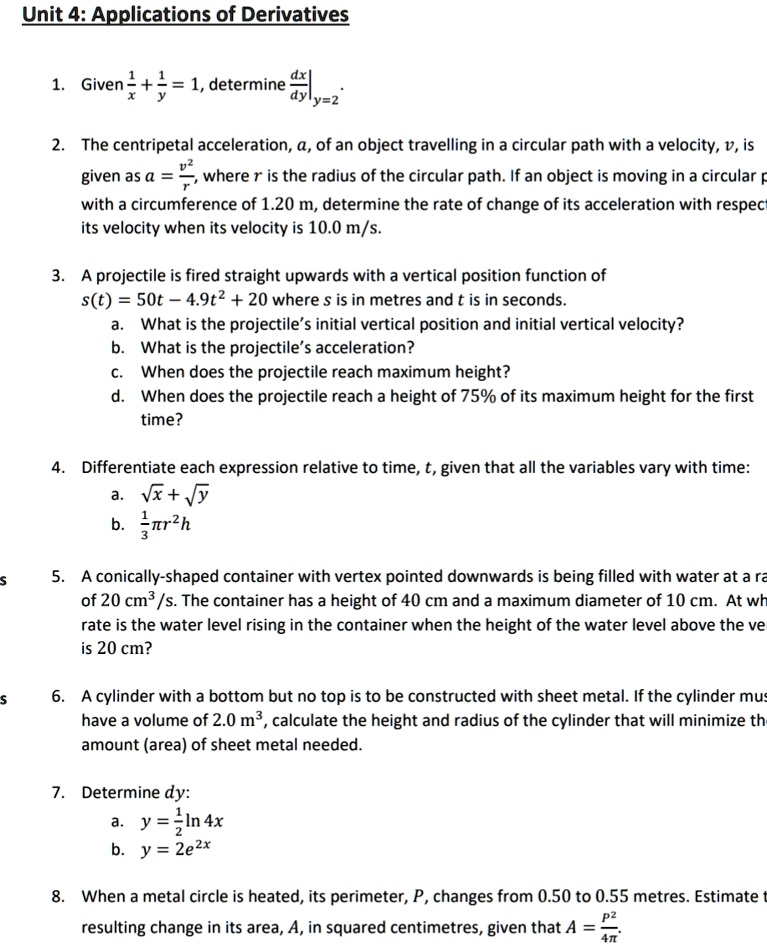
1. Given $$ \frac{1}{x} + \frac{1}{y} = 1 $$, determine $$ \frac{dx}{dy}|_{y=2} $$.
2. The centripetal acceleration, a, of an object travelling in a circular path with a velocity, v, is given as $$ a = \frac{v^2}{r} $$, where r is the radius of the circular path. If an object is moving in a circular path with a circumference of 1.20 m, determine the rate of change of its acceleration with respect to its velocity when its velocity is 10.0 m/s.
3. A projectile is fired straight upwards with a vertical position function of $$ s(t) = 50t - 4.9t^2 + 20 $$ where s is in metres and t is in seconds.
a. What is the projectile's initial vertical position and initial vertical velocity?
b. What is the projectile's acceleration?
c. When does the projectile reach maximum height?
d. When does the projectile reach a height of 75% of its maximum height for the first time?
4. Differentiate each expression relative to time, t, given that all the variables vary with time:
a. $$ \sqrt{x} + \sqrt{y} $$
b. $$ \frac{1}{3} \pi r^2 h $$
5. A conically-shaped container with vertex pointed downwards is being filled with water at a rate of 20 cm³/s. The container has a height of 40 cm and a maximum diameter of 10 cm. At what rate is the water level rising in the container when the height of the water level above the vertex is 20 cm?
6. A cylinder with a bottom but no top is to be constructed with sheet metal. If the cylinder must have a volume of 2.0 m³, calculate the height and radius of the cylinder that will minimize the amount (area) of sheet metal needed.
7. Determine dy:
a. $$ y = \frac{1}{2} \ln 4x $$
b. $$ y = 2e^{2x} $$
8. When a metal circle is heated, its perimeter, P, changes from 0.50 to 0.55 metres. Estimate the resulting change in its area, A, in squared centimetres, given that $$ A = \frac{P^2}{4\pi} $$.