Part 2: The cell membrane is a capacitor! The inside and outside of a neuron are separated by
the cell membrane a 4 nm thick insulator made up of molecules called lipids. The inside and
outside of the cell are salt water, with an excess of potassium ions K+ on the inside of the cell
and an excess of Na' outside the cell when the cell is in its "resting" state. Even though the ions
have equal charges (+1e), they are not equal in concentration inside and outside the cell. (We
will ignore other ions like Cl, Ca2+, etc in this problem.) Thus, the cell membrane looks like
charged "plates" separated by a small distance a capacitor! In this problem we will explore
the details of membrane capacitance, an important piece of our model of electrical
communication in neurons.
F
(a) The capacitance of a cell membrane can be measured fairly straightforwardly, and is about
$10^{-2} \frac{F}{m^2}$. (It is typical to report them in this way, as a capacitance per unit area.) In a
"resting neuron" the potential difference between the inside and outside of the cell (ie,
across the membrane) is about -60 mV, with the interior of the cell held at a lower
potential than the outside. Imagine a small square area of the membrane measuring about
50 nm on a side. Calculate the capacitance of this region of membrane, and the charge Q on
the "capacitor."
(b) Are there equal numbers of K and Na on either side of the membrane? Explain. If there is
an excess of one type of ion over the other, what is their difference in number in the small
patch of membrane considered in (a)? Explain.
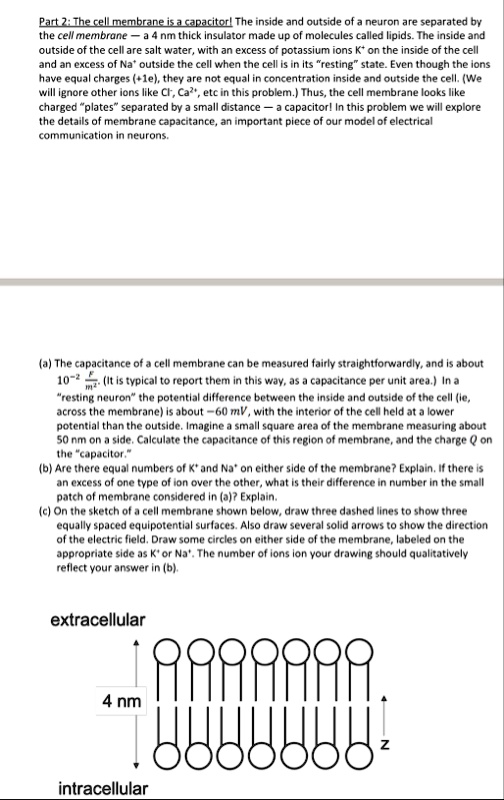
(c) On the sketch of a cell membrane shown below, draw three dashed lines to show three
equally spaced equipotential surfaces. Also draw several solid arrows to show the direction
of the electric field. Draw some circles on either side of the membrane, labeled on the
appropriate side as K' or Nat. The number of ions ion your drawing should qualitatively
reflect your answer in (b).
extracellular
4 nm
AAAAAAA
8888888
Z
▼
intracellular