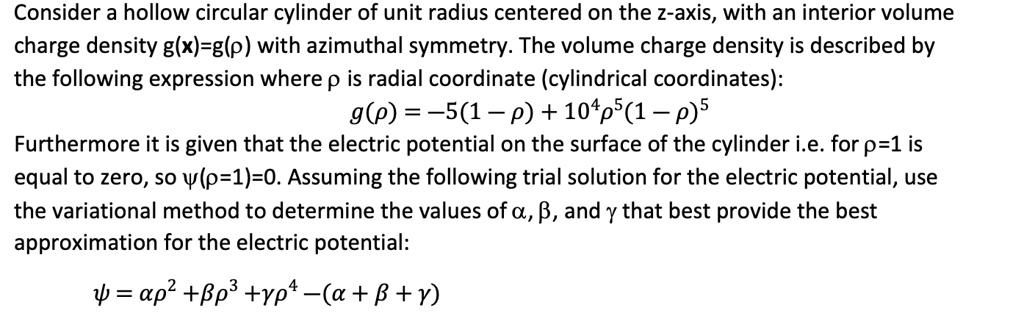
Consider a hollow circular cylinder of unit radius centered on the z-axis, with an interior volume charge density $g(x) = g(\rho)$ with azimuthal symmetry. The volume charge density is described by the following expression where $\rho$ is radial coordinate (cylindrical coordinates):
$g(\rho) = -5(1 - \rho) + 10^4 \rho^5 (1 - \rho)^5$
Furthermore it is given that the electric potential on the surface of the cylinder i.e. for $\rho = 1$ is equal to zero, so $\psi(\rho = 1) = 0$. Assuming the following trial solution for the electric potential, use the variational method to determine the values of $\alpha$, $\beta$, and $\gamma$ that best provide the best approximation for the electric potential:
$\psi = \alpha \rho^2 + \beta \rho^3 + \gamma \rho^4 - (\alpha + \beta + \gamma)$