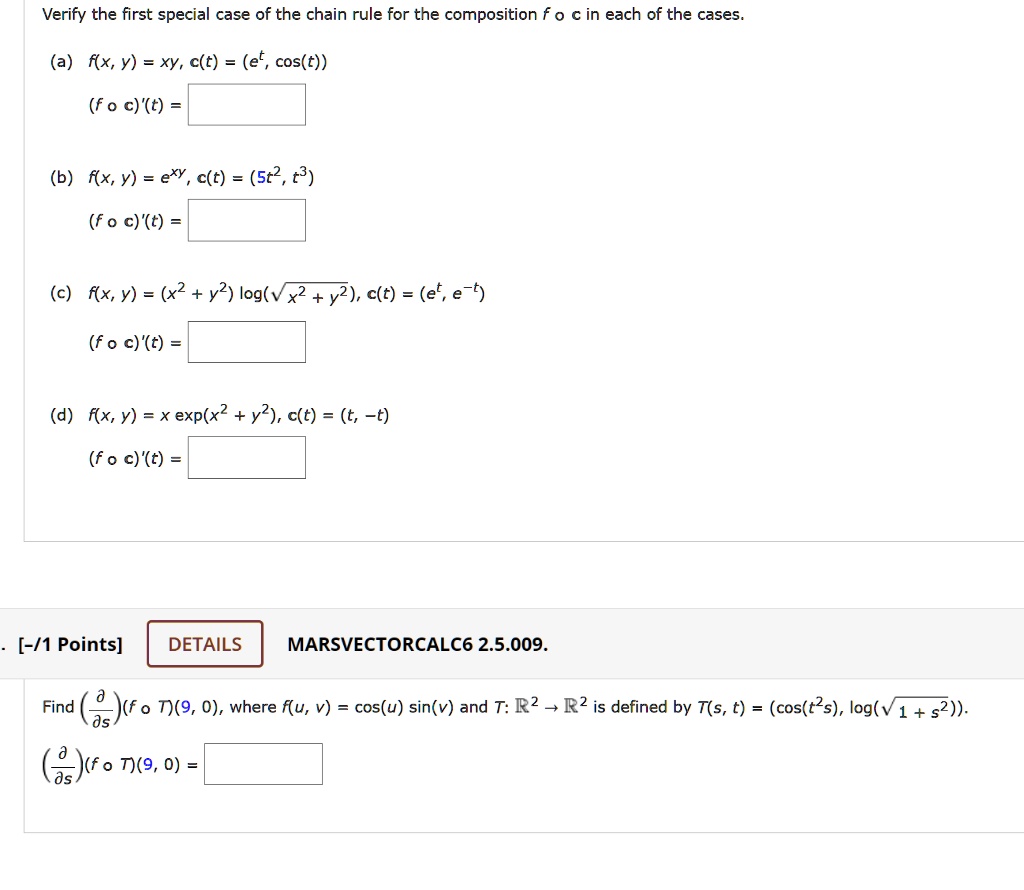
Verify the first special case of the chain rule for the composition $f \circ c$ in each of the cases.
(a) $f(x, y) = xy$, $c(t) = (e^t, \cos(t))$
$(f \circ c)'(t) = $
(b) $f(x, y) = e^{xy}$, $c(t) = (5t^2, t^3)$
$(f \circ c)'(t) = $
(c) $f(x, y) = (x^2 + y^2) \log(\sqrt{x^2 + y^2})$, $c(t) = (e^t, e^{-t})$
$(f \circ c)'(t) = $
(d) $f(x, y) = x \exp(x^2 + y^2)$, $c(t) = (t, -t)$
$(f \circ c)'(t) = $
. [-/1 Points] DETAILS MARSVECTORCALC6 2.5.009.
Find $\frac{\partial}{\partial s} (f \circ T)(9, 0)$, where $f(u, v) = \cos(u) \sin(v)$ and $T: \mathbb{R}^2 \to \mathbb{R}^2$ is defined by $T(s, t) = (\cos(t^2s), \log(\sqrt{1 + s^2})).$
$\frac{\partial}{\partial s} (f \circ T)(9, 0) = $