Read the following article, which introduces the household and establishment surveys conducted by the Bureau of Labor Statistics. Then answer the
question that follows.
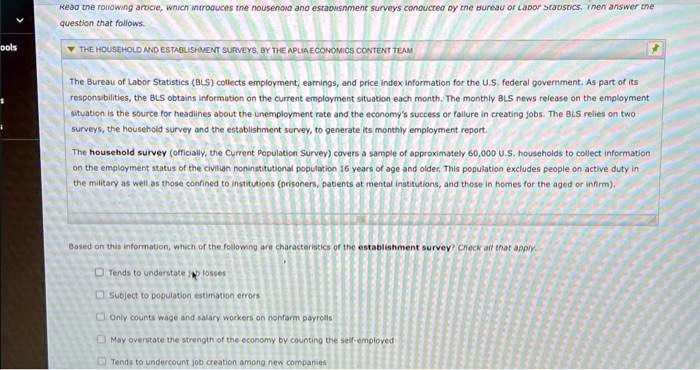
THE HOUSEHOLD AND ESTABLISHMENT SURVEYS, BY THE APIA ECONOMICS CONTENT TEAM
The Bureau of Labor Statistics (BLS) collects employment, earnings, and price index information for the U.S. federal government. As part of its
responsibilities, the BLS obtains information on the current employment situation each month. The monthly BLS news release on the employment
situation is the source for headlines about the unemployment rate and the economy's success or failure in creating jobs. The BLS relies on two
surveys, the household survey and the establishment survey, to generate its monthly employment report.
The household survey (officially, the Current Population Survey) covers a sample of approximately 60,000 U.S. households to collect information
on the employment status of the civilian noninstitutional population 16 years of age and older. This population excludes people on active duty in
the military as well as those confined to institutions (prisoners, patients at mental institutions, and those in homes for the aged or infirm).
Based on this information, which of the following are characteristics of the establishment survey? Check all that apply.
Tends to understate job losses
Subject to population estimation errors
Only counts wage and salary workers on nonfarm payrolls
May overstate the strength of the economy by counting the self-employed
Tends to undercount job creation among new companies