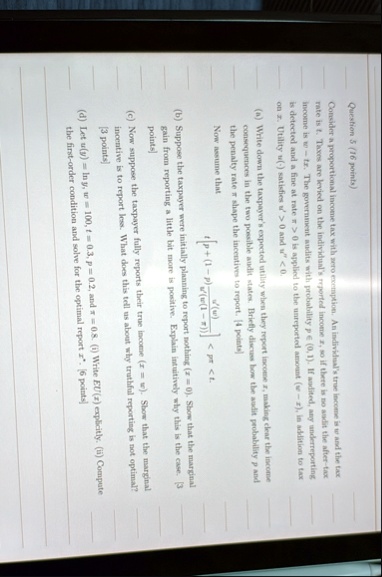
Question 3 (16 points)
Consider a proportional income tax with zero exemption. An individual's true income is w and the tax rate is t. Taxes are levied on the individual's reported income z, so if there is no audit the after-tax income is $w - tz$. The government audits with probability $p \in (0, 1)$. If audited, any underreporting is detected and a fine at rate $\pi > 0$ is applied to the unreported amount $(w - z)$, in addition to tax on z. Utility $u(\cdot)$ satisfies $u' > 0$ and $u'' < 0$.
(a) Write down the taxpayer's expected utility when they report income z, making clear the income consequences in the two possible audit states. Briefly discuss how the audit probability p and the penalty rate $\pi$ shape the incentives to report. [4 points]
Now assume that
$$ \frac{t}{p + (1 - p)\frac{u'(w)}{u'(w(1 - \pi))}} < p\pi < t. $$
(b) Suppose the taxpayer were initially planning to report nothing $(z = 0)$. Show that the marginal gain from reporting a little bit more is positive. Explain intuitively why this is the case. [3 points]
(c) Now suppose the taxpayer fully reports their true income $(z = w)$. Show that the marginal incentive is to report less. What does this tell us about why truthful reporting is not optimal? [3 points]
(d) Let $u(y) = \ln y$, $w = 100$, $t = 0.3$, $p = 0.2$, and $\pi = 0.8$. (i) Write $EU(z)$ explicitly. (ii) Compute the first-order condition and solve for the optimal report $z^*$. [6 points]