Ace - AI Tutor
Ask Our Educators
Textbooks
My Library
Flashcards
Scribe - AI Notes
Notes & Exams
Download App
daniel kelly

daniel k.

Divider

Questions asked

BEST MATCH

Which international trade theory suggests that commercializing an innovative product or service means that a firm will have a competitive advantage?

View Answer
divider
BEST MATCH

A sample of n = 25 scores produces a t statistic of t = +2.052. If the researcher is conducting a two-tailed hypothesis test, which of the following is the correct statistical decision?

View Answer
divider
BEST MATCH

Weber's ethic of \_\_\_\_\_ requires that a national leader, as a moral actor, consider his or her responsibilities to the people that depend on the leader for safety and security. determination responsibility quality care

View Answer
divider
BEST MATCH

the stability of a motorcycle rider is an important area for study

View Answer
divider
BEST MATCH

Which of the trinomials below is a perfect square of a binomial? Select the correct answer below: $16x^2 + 12x + 9$ $9x^2 - 9x + 1$ $16x^2 + 40x + 25$ $25x^2 - 80x + 16$ $-2x^2 + 4x - 1$

View Answer
divider
BEST MATCH

asses through the point (-3,7) and is parallel to the x axis

View Answer
divider
BEST MATCH

What is the function of pulmonary surfactant? trap and remove debris that reaches the alveoli aid in the exchange of gases in/out of the alveoli decrease friction within the lung tissue decrease the surface tension of the fluid in the alveoli prevent nitrogen from being exchanged with the blood

View Answer
divider
BEST MATCH

Question 18 The DSM-V defines addiction in terms of _______________. number of synapses involved severity of dopamine levels behavior chemical involved

View Answer
divider
BEST MATCH

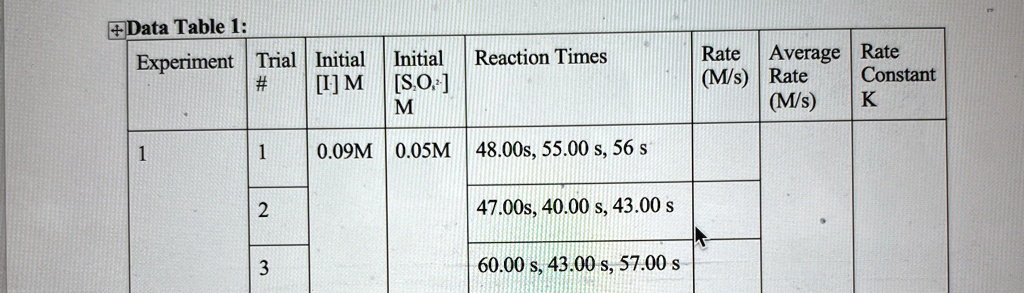
Parts 1: The Effect of Concentration Please choose one experiment (1-5) and perform the following calculations. (1) Show one calculation of the initial concentration of I^(-)and S_(2)O_(8)^(2-). (This is the concentration when the reaction begins) (2) Show one calculation of the rate of reaction 1 with the unit of (M)/(s) (molar per second). The rate of reaction can be calculated from Delta (I_(2))/(Delta )t. Delta [I_(2)] is the amount of I_(2) produced from reaction 1 . These I_(2) react with S_(2)O_(3)^(2-) and won't become I_(3)^(-)until S_(2)O_(3)^(2-) all has been consumed. Therefore, you can determine Delta [I_(2)] from the amount of S_(2)O_(3)^(2-). (3) Show a calculation of the average rate of reaction. (4) Show how you determine the reaction order ( x ) of I. You can use experiment 1 and 2 or 2 and 3 or 1 and 3 to determine the reaction order of I^(-). Pick a pair of experiments and use the initial rates method (Example calculation on page 9) to find the value for x. Pick a different combination of experiment 1-3 to verify the value obtained for x. Show the calculated value with significant figures and then round the value to the nearest whole number. (5) Show how you determine the reaction order ( y ) of S_(2)O_(8)^(2-). Similar to the value of x, use experiment 2,4 and 5 to determine the value of y. Show the calculated value with significant figures and then round the value to the nearest whole number. (6) Show how you determine an average rate constant (k). You will need to substitute x,y, and the rate of reaction to the rate law of reaction 1 . Then, calculate and report the rate constant (k) for each experiment with appropriate significant figures. Show only one calculation example in your report. Note that the unit of rate constants in a first-, second-, and third-order reaction are different. Make sure you show how you come up with the unit of the rate constant. Rate of reaction 1=k[I^(-)]^(x)[S_(2)O_(8)^(2-)]^(y) able[[Rate Law,Overall Reaction Order,Units for k +Data Table 1 Experiment Trial Initial Initial Reaction Times # [I]M [S.0] M Rate Average Rate (M/s) Rate Constant (M/s) K 1 1 0.09M 0.05M 48.00s,55.00 s,56 s 2 47.00s, 40.00 s, 43.00 s 3 60.00s.43.00 s.57.00 s
View Answer
divider
BEST MATCH

A partnership is a taxable entity for income tax purposes. A partnership is a taxable entity for GST purposes. In general, provincial income taxes for individuals are based on a specified percentage of federal income tax payable. The federal government does not collect personal or corporate income taxes for Ontario or Quebec. A sales tax is a regressive tax even when it is applied at a single rate on all transactions. Tax expenditures are less costly to administer than direct funding programs. Part I of the ITA (Income Tax Act) is the largest and most important part. The citation ITA 61(4)(b)(ii) would be read Paragraph 61, Subparagraph 4, Section b, Subsection ii. Canadian citizens are required to file a Canadian income tax return, without regard to where they reside. If an individual leaves Canada, the three most significant factors in determining whether the individual has ceased to be a resident are: Whether (s)/(h)e continues to own a dwelling in Canada. -Whether s/he is accompanied by his spouse or common-law partner. -Whether s/he maintains social ties in Canada. If an individual returns to Canada after an absence of less than two years the individual will be considered to have retained Canadian residency during his absence. 1. A partnership is a taxable entity for income tax purposes. 2. A partnership is a taxable entity for GST purposes. 3. In general,provincial income taxes for individuals are based on a specified percentage of federal income tax payable. 4. The federal government does not collect personal or corporate income taxes for Ontario or Quebec. 5. A sales tax is a regressive tax even when it is applied at a single rate on all transactions. 6. Tax expenditures are less costly to administer than direct funding programs. 7. Part I of the ITA (Income Tax Act) is the largest and most important part. 8.The citation ITA 614(b)(ii would be read Paragraph 61,Subparagraph 4, Section b Subsection ii. 9. Canadian citizens are required to file a Canadian income tax return, without regard to where they reside. l0.If an individual leaves Canada, the three most significant factors in determining whether the individual has ceased to be a resident are: Whether s/he continues to own a dwelling in Canada. - Whether s/he is accompanied by his spouse or common-law partner. - Whether s/he maintains social ties in Canada. l1.If an individual returns to Canada after an absence of less than two years the individual will be considered to have retained Canadian residency during his absence

View Answer
divider