APPLIED DYNAMICS
Lesson 4 Problems:
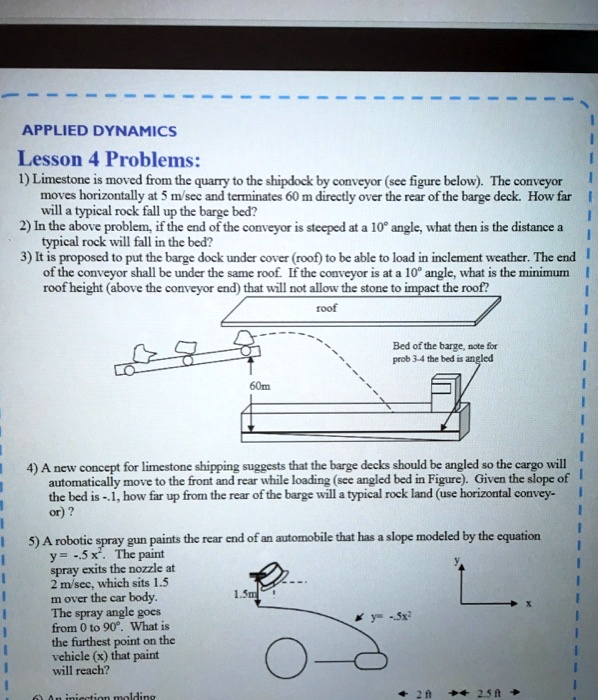
1) Limestone is moved from the quarry to the shipdock by conveyor (see figure below). The conveyor
moves horizontally at 5 m/sec and terminates 60 m directly over the rear of the barge deck. How far
will a typical rock fall up the barge bed?
2) In the above problem, if the end of the conveyor is steeped at a 10° angle, what then is the distance a
typical rock will fall in the bed?
3) It is proposed to put the barge dock under cover (roof) to be able to load in inclement weather. The end
of the conveyor shall be under the same roof. If the conveyor is at a 10° angle, what is the minimum
roof height (above the conveyor end) that will not allow the stone to impact the roof?
roof
60m
Bed of the barge, note for
prob 3-4 the bed is angled
4) A new concept for limestone shipping suggests that the barge decks should be angled so the cargo will
automatically move to the front and rear while loading (see angled bed in Figure). Given the slope of
the bed is -.1, how far up from the rear of the barge will a typical rock land (use horizontal convey-
or)?
5) A robotic spray gun paints the rear end of an automobile that has a slope modeled by the equation
y = -.5 x². The paint
spray exits the nozzle at
2 m/sec, which sits 1.5
m over the car body.
The spray angle goes
from 0 to 90°. What is
the furthest point on the
vehicle (x) that paint
will reach?
6) An injection molding
1.5m
y = -.5x²
2 ft
2.5 ft