2.
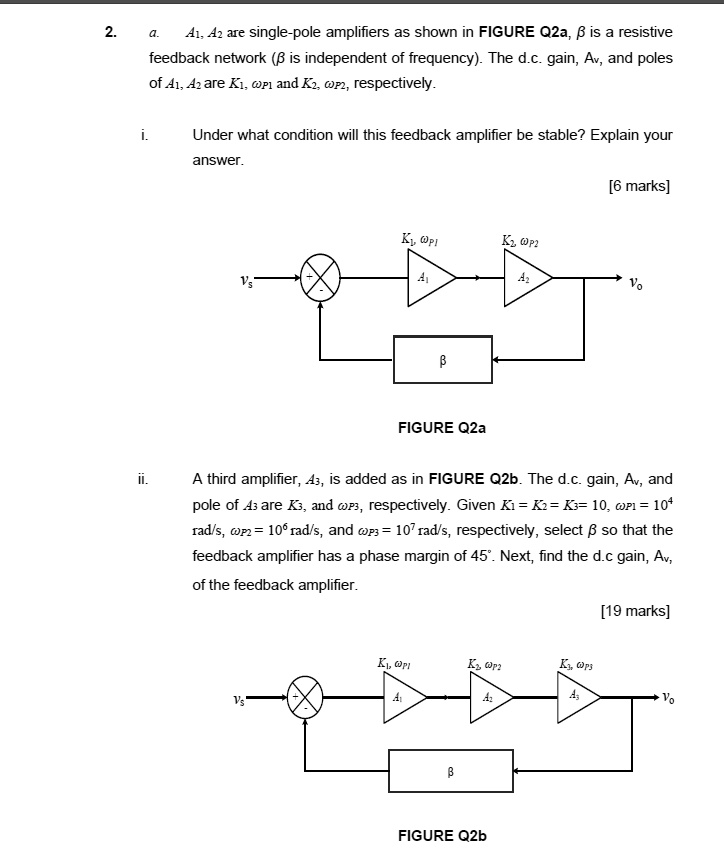
a. A1, A2 are single-pole amplifiers as shown in FIGURE Q2a, \(\beta\) is a resistive
feedback network (\(\beta\) is independent of frequency). The d.c. gain, Av, and poles
of A1, A2 are K1, \(\omega_{p1}\) and K2, \(\omega_{p2}\), respectively.
i. Under what condition will this feedback amplifier be stable? Explain your
answer.
[6 marks]
ii. A third amplifier, A3, is added as in FIGURE Q2b. The d.c. gain, Av, and
pole of A3 are K3, and \(\omega_{p3}\), respectively. Given K1 = K2 = K3= 10, \(\omega_{p1} = 10^4\)
rad/s, \(\omega_{p2} = 10^6\) rad/s, and \(\omega_{p3} = 10^7\) rad/s, respectively, select \(\beta\) so that the
feedback amplifier has a phase margin of 45°. Next, find the d.c gain, Av,
of the feedback amplifier.
[19 marks]