A point on the edge of a circular plate with radius 2 m is being heated. During the process, a grid of sensors on the plate
is used to measure the temperature distribution. To help record the data, a Cartesian coordinate system is established on
the plate with its origin at the center. The temperature T (in °C) of the plate may then be regarded as a function of x
and y (in meters), and t (in seconds). From this data, it is estimated that
$$
\frac{\partial T}{\partial x}\bigg|_{x=-1.03, y=0.73, t=113} = -3.6 \text{ °C/m},
$$
$$
\frac{\partial T}{\partial y}\bigg|_{x=-1.03, y=0.73, t=113} = -3.48 \text{ °C/m},
$$
and
$$
\frac{\partial T}{\partial t}\bigg|_{x=-1.03, y=0.73, t=113} = 0.49 \text{ °C/s}.
$$
Later in the analysis of the data, it is decided that polar coordinates would be more convenient, so T should be regarded
as a function of r (in meters), θ (in radians), and t (in seconds) instead. Find
$$
\frac{\partial T}{\partial r}\bigg|_{r=r_0, \theta=\theta_0, t=113}
$$
and
$$
\frac{\partial T}{\partial \theta}\bigg|_{r=r_0, \theta=\theta_0, t=113}
$$
where (r, θ) = (r_0, θ_0) are the polar coordinates of the point with Cartesian coordinates (x, y) = (-1.03, 0.73).
$$
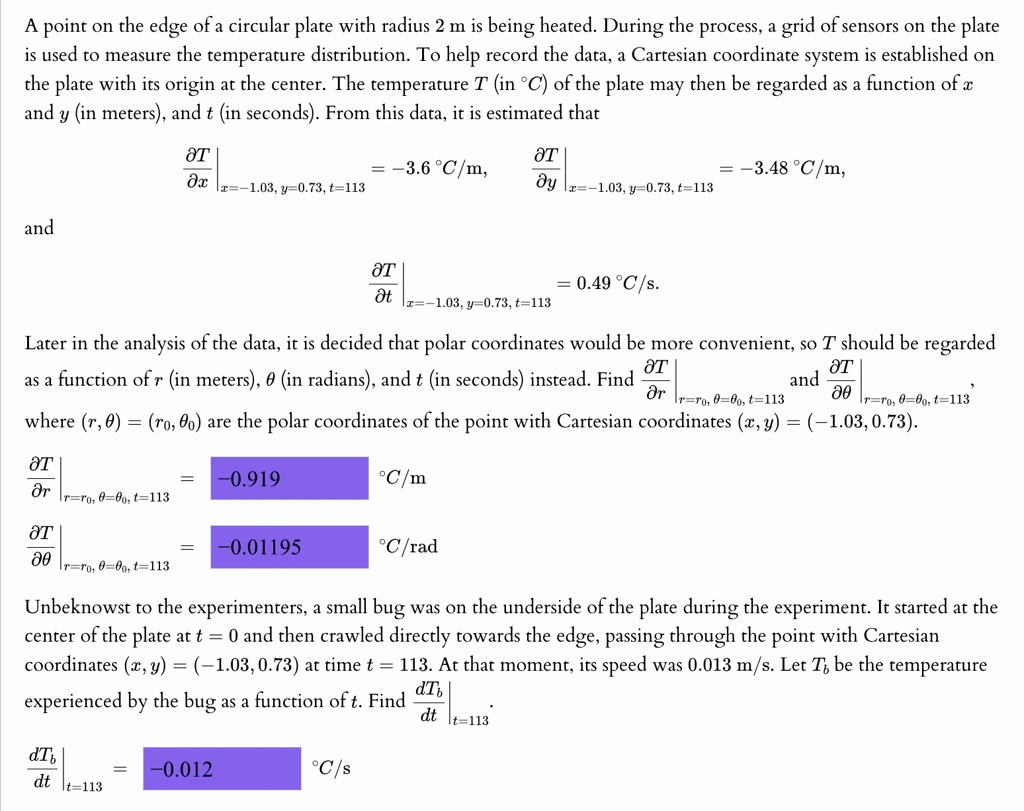
\frac{\partial T}{\partial r}\bigg|_{r=r_0, \theta=\theta_0, t=113} = -0.919 \text{ °C/m}
$$
$$
\frac{\partial T}{\partial \theta}\bigg|_{r=r_0, \theta=\theta_0, t=113} = -0.01195 \text{ °C/rad}
$$
Unbeknowst to the experimenters, a small bug was on the underside of the plate during the experiment. It started at the
center of the plate at t = 0 and then crawled directly towards the edge, passing through the point with Cartesian
coordinates (x, y) = (-1.03, 0.73) at time t = 113. At that moment, its speed was 0.013 m/s. Let T_b be the temperature
experienced by the bug as a function of t. Find
$$
\frac{dT_b}{dt}\bigg|_{t=113}
$$
$$
\frac{dT_b}{dt}\bigg|_{t=113} = -0.012 \text{ °C/s}
$$