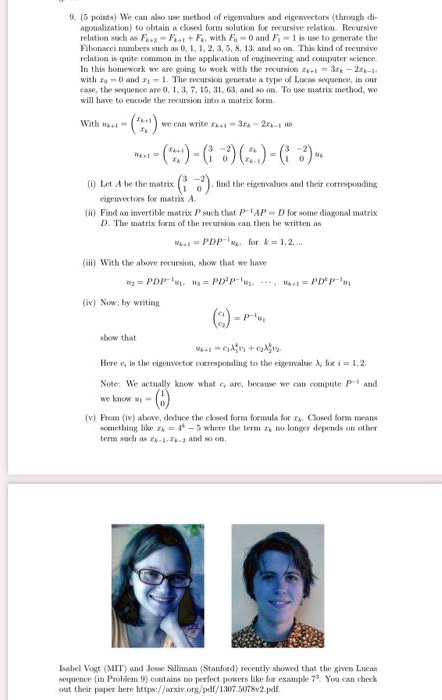
We can also use the method of eigenvalues and eigenvectors (through diagonalization) to obtain a closed-form solution for a recursive relation. A recursive relation such as Fₙ₊₠= Fₙ + Fₙ₋₠with F₀ = 0 and F₠= 1 is used to generate the Fibonacci numbers such as 0, 1, 1, 2, 3, 5, 8, 13, and so on. This kind of recursive relation is quite common in the applications of engineering and computer science.
In this case, the sequence is 0, 1, 3, 7, 15, 31, 63, and so on. To use the matrix method, we will have to encode the recursion into a matrix form.
With P = [[1, 1], [1, 0]], we can write Fₙ₊₠= P * Fₙ as
[ Fₙ₊₠] [ 1 1 ] [ Fₙ ]
[ ] = [ ] * [ ]
[ Fₙ ] [ 1 0 ] [ Fₙ₋₠]
Find an invertible matrix P such that Pâ»Â¹AP = D for some diagonal matrix D. The matrix form of the recursion can then be written as
[ Fₙ₊₠] [ λ₠0 ] [ Fₙ ]
[ ] = [ ] * [ ]
[ Fₙ ] [ 0 λ₂ ] [ Fₙ₋₠]
With the above recursion, show that we have Fₙ₊₂ = λâ‚Fₙ₊₠+ λ₂Fâ‚™.
Now, by writing Fₙ₊₂ = P²Fₙ, show that P² = P + I.
Here λ₠and λ₂ are the eigenvalues corresponding to the eigenvectors P₠and P₂, for i = 1, 2.
Note: We actually know what λ₠and λ₂ are because we can compute Pâ»Â¹ and we know P² = P + I.
From the equation in (iv) above, deduce the closed-form formula for Fâ‚™. Closed-form means something like Fâ‚™ = 4/5 where the term Fâ‚™ no longer depends on other terms such as Fₙ₋â‚, Fₙ₋₂, and so on.
Isabel Vogt (MIT) and Jesse Silliman (Stanford) recently showed that the given Lucas sequence (in Problem 9) contains no perfect powers. For example, 7 is not a perfect power. You can check out their paper here: https://arxiv.org/pdf/1307.5078v2.pdf.